

Ebservant is reader-supported: some links on this page are affiliate links, and as an Amazon Associate Ebservant earns from qualifying purchases at no extra cost to you. Learn more.
Home theater seating prices range from $159.99 to $5199.99, with most buyers selecting options between $579.09 and $2149.99. As the price rises, the cost per unit of weight capacity increases from $0.61 at the entry level to $8.80 at the top end.
Home Theater Seat Price Levels at a Glance
| Price level | Price range | Products | Median weight capacity | Median rating |
|---|---|---|---|---|
| Entry level | $159.99 to $559.99 | 6 | 625 lbs | 4.3 |
| Lower mid-range | $579.09 to $859.99 | 6 | 350 lbs | 4.5 |
| Upper mid-range | $879.99 to $2149.99 | 6 | 300 lbs | 4.7 |
| Top end | $2599.99 to $5199.99 | 6 | 350 lbs | 4.6 |
Products in this category with a full review here
From $859.99 to $2149.99: 3 of the 15 in this category we have reviewed in full.
If you are building a gaming setup, browse our top picks for gaming theater seats.

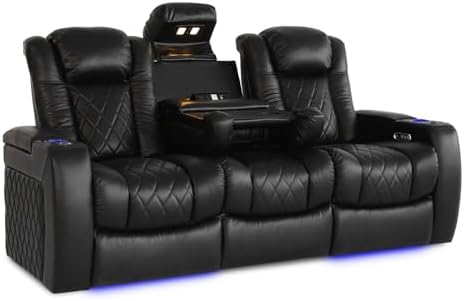

What does entry level home theater seating offer?
Entry level home theater seating provides a functional base for a small viewing area at a median price of $328.22. This price point typically includes manual recline mechanisms and standard polyester or synthetic upholstery. If you are looking for a single chair for a small bedroom setup, these options provide the necessary reclining motion without the costs of integrated electronics.
Entry level home theater seats offer high weight capacity and firm foam
The entry level is characterized by a median weight capacity of 625 lbs. This high weight capacity relative to price suggests a focus on heavy-duty steel frames and high-density foam. However, these seats often lack power lumbar support or headrest adjustments, which are common in higher tiers. You may find that the foam feels firmer than higher-end models because lower-cost materials are used to maintain the structural integrity of the frame.
Before making a final purchase, learn how home theater seat warranties work.
Budget home theater seats provide basic functionality with standardized dimensions
A common issue at this price point is the lack of specialized padding. Because the budget is constrained, the seat depth and width are often standardized, which may not accommodate larger frames comfortably. If your priority is basic functionality over luxury, these models provide the most weight capacity per dollar spent.
What do lower mid-range home theater seating options provide?
Lower mid-range home theater seating provides a balance of comfort and build quality at a median price of $598.99. This level often introduces higher-quality upholstery, such as chenille or basic leather, and may offer improved cushioning. It suits users who want a more substantial feel than entry-level models but do not require the advanced features of the upper tiers.
Understanding the basics is easier when you see the different types of home theater seats.
You gain significant improvements in the tactile feel of the fabric and the density of the foam. These seats often feature more robust internal frames that reduce the risk of frame torque and structural flex during repeated use.
Mid-range home theater seats offer refined comfort with manual adjustments
Compared to the entry level, these seats offer a more refined seating experience. However, they still typically rely on manual operation. If you require power-driven adjustments, you will need to move to the upper mid-range. The primary trade-off here is the loss of the extreme weight-to-price ratio found in the lowest tier in exchange for a more comfortable seating surface.
To ensure your chair fits in your room, see how to choose your total depth.
What does upper mid-range home theater seating provide?
Upper mid-range home theater seating provides advanced comfort features and power functionality at a median price of $1314.99. This level is where many users find the “sweet spot” for home cinema, as it often includes power recline and power headrest adjustments. It suits users who prioritize ease of use and personalized postural support.
Upper mid-range home theater seats use specialized foam for long-term support
The median weight capacity at this level is 300 lbs. While the weight limit is lower than the entry-level options, the focus shifts toward the mechanics of the power system. These chairs often feature specialized foam densities to prevent foam compression set, which is the permanent loss of shape in the cushion. This ensures the seat remains supportive over years of use.
Newcomers can learn about the mechanics in our home theater seat explained guide.
Power features and premium leather increase upper mid-range home theater seat costs
You gain the ability to adjust your position with a button press, which is a significant upgrade over manual levers. This level also typically features higher-grade materials, such as top grain leather, which offers better breathability than synthetic options. The trade-off is a higher price per unit of weight capacity, moving from $1.69 to $4.17. You are paying for the motors, the electronics, and the premium materials rather than raw structural mass.
What does top end home theater seating provide?
Top end home theater seating provides a luxury experience with premium materials and specialized engineering at a median price of $3399.50. This tier is for users who want the highest level of comfort and durability available in the market. It often features specialized designs and high-cycle durability similar to commercial grade cinema seating.
Make sure everyone is comfortable by learning how to choose your seat width.
Top-tier home theater seats prioritize material quality and sophisticated seating experiences
The median weight capacity for these top-tier options is 350 lbs. At this price, the focus is almost entirely on the quality of the materials and the sophistication of the seating experience. These chairs may feature specialized foam and high-quality leather that is designed to withstand heavy use without sagging. The price per unit of weight capacity reaches its peak at $8.80.
If these options are too bulky, look into home theater seat alternatives for small spaces.
High-end home theater seats provide boutique comfort and smooth power movements
If you are building a high-end home theater, this level provides the most consistent comfort. The gain here is in the “feel” of the chair—the softness of the leather, the smoothness of the power movements, and the durability of the construction. You give up significant cost-efficiency for these refinements. If you do not require a boutique experience, the jump from the upper mid-range to the top end offers diminishing returns in terms of physical specifications.
Where does paying more stop buying more?
Paying more stops providing significant functional gains once you reach the upper mid-range, as the price per unit of weight capacity more than doubles from $1.69 to $4.17. The most significant leap in utility occurs between the lower mid-range and the upper mid-range, where the addition of power features and better materials justifies the price increase. Beyond the $1314.99 median, the cost continues to rise sharply toward the $3399.50 median, but the weight capacity remains stagnant at 350 lbs.
Discover more about the reclining experience in our full Weilianda Zero Gravity Recliner review.
Upper mid-range home theater seats offer the best feature concentration per dollar
While you receive a more luxurious product, the core specifications—like the weight capacity—do not increase. The difference between a $2149.99 chair and a $3399.50 chair is primarily in the quality of the upholstery and the precision of the motorized movements. If you do not require a specific boutique design, the upper mid-range provides the highest concentration of features per dollar.
What to budget for on top of the product?
Budgeting for home theater seating requires accounting for accessories and infrastructure that ensure the chair functions correctly. You will need to ensure that any motorized chair has a dedicated power supply cable that can reach your wall outlet without being strained or pinched by the reclining mechanism.
Check out the specifications in our full Charles RV Recliner review.
Seat covers protect home theater chair upholstery from spills and wear
To maintain the upholstery, you should consider seat covers. These protect the material from spills and wear, which is especially important for leather or high-end fabric. If you plan to use the chair for snacks or drinks, these covers provide a necessary layer of protection. You must ensure the covers are sized to match the specific dimensions of your chair’s seat and back.
Cup holder inserts provide secure beverage storage for home theater chairs
For those who want to keep beverages within reach, cup holder inserts provide a secure place for beverages. These are often sold separately and must be compatible with the specific armrest design of your chair. Because these items are often sold as add-ons, the total cost of the seating setup can increase depending on how many accessories you choose to include.
See the technical details in our full Tuscany 2025 Recliner review.
How can a buyer tell a fair price?
A buyer can tell a fair price by calculating the price per unit of weight capacity and comparing it to the median values for that price level. If the resulting figure is lower than the $4.17 median for the upper mid-range, it represents a high value for the structural strength provided.
Price per unit of weight capacity reveals extra features in home theater seats
When comparing two chairs with the same weight capacity, use the price per unit of weight capacity to see which one offers more “free” features. If two chairs both support 350 lbs, the one with the lower price per unit is offering more features—like power recline or better materials—for the same structural cost. This allows you to see exactly what you are paying for in each tier.
View the premium leather specs in our full Valencia Tuscany Recliner review.
Entry-level home theater seats provide the most economical high weight capacity
You should also consider the specific requirements of your household. If you need a chair that supports a weight higher than the 300 lb or 350 lb medians, the price per unit of weight capacity becomes a more critical metric. In those cases, the entry-level range, which has a 625 lb median, provides the most economical way to achieve a high weight capacity. Use these medians as a baseline to ensure you are not overpaying for basic structural requirements.