

Ebservant is reader-supported: some links on this page are affiliate links, and as an Amazon Associate Ebservant earns from qualifying purchases at no extra cost to you. Learn more.
Recline Angle for home theater seating is the degree of backward tilt a chair provides from a vertical sitting position to a fully reclined state. You determine the correct angle by identifying your preferred viewing distance and the physical space available in your room.
If you prefer a high-end feel, browse our list of best luxury leather home theater seats.
Which Recline Angle Suits Your Setup?
| If this is you | The Recline Angle that suits you | Why |
|---|---|---|
| You prefer a standard cinema experience with a focused, upright view. | 110 deg to 125 deg | These angles provide a comfortable tilt for watching content without significantly altering your posture or visibility of the screen. |
| You prioritize maximum relaxation and “zero-gravity” style lounging. | 135 deg to 150 deg | Higher degrees allow the body to distribute weight more evenly across the backrest and seat, reducing pressure on the lower spine. |
| You have a very small room with limited floor space behind the chair. | 105 deg to 115 deg | Lower recline angles require less clearance behind the headrest, preventing the chair from hitting a wall or furniture. |
| You are a tall individual who needs significant upper-body support. | 125 deg to 140 deg | A moderate-to-high tilt helps distribute the weight of a larger frame across the padding of the chair’s backrest. |
Where these choices show up in our reviews
From $371.44 to $1999.99: 3 of the 15 in this category we have reviewed in full.
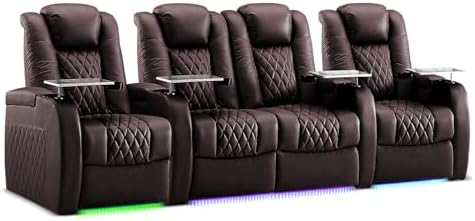
For snack lovers, see which models have the best home theater seating with tray table.

How do I measure my ideal Recline Angle for home theater seating?
To establish your personal Recline Angle, you must identify the degree of tilt that feels natural for your body when viewing a screen from your intended distance. This measurement is typically found in the technical specifications of the chair, often listed as the “Maximum Recline” or “Recline Range.”
Families with many members should view our guide on best home theater seating for large families.
Budget-conscious travelers can find affordable RV and van loveseat recliners under $1000.
Checking your room’s physical clearance for recline
You must measure the distance between the back of your current chair and the wall or nearest obstacle. A chair with a 150 deg recline angle requires significantly more depth than one limited to 110 deg because the headrest moves outward as it tilts back. If your clearance is less than 30 cm from the wall, you should look for a chair with a lower maximum degree to ensure the headrest does not strike the surface.
Players seeking high performance should see our guide to best home theater seating for gaming.
Testing your preferred viewing angle at home
You can determine your preferred angle by using a standard kitchen chair or a lounge chair and marking the position of your head relative to the screen. Sit in your intended viewing position and find the tilt where your eyes are level with the center of the screen without straining your neck. Measure the angle of the backrest at this point using a protractor or a smartphone inclinometer app; this number is the Recline Angle you should seek in new home theater seating.
If you want extra comfort features, see our comparison of the best power recliner with massage and heat.
Small rooms can benefit from our analysis of best space-saving home theater seating.
What happens if the Recline Angle is too high or too low?
A Recline Angle that is too low for your preference results in a “perched” feeling where the weight of your upper body remains concentrated on your lower back and hips. This can lead to muscle fatigue during long movie sessions because the chair does not provide enough of a tilt to distribute your weight across the backrest.
Understanding dimensions is key, so learn how to choose your total depth for home theater seats.
The physical impact of a low Recline Angle
When the angle is too shallow, the seat remains the primary weight-bearing surface. This can cause the foam to compress more quickly in the seat base, leading to a “bottomed-out” feel where you feel the frame of the chair. If you prefer a lounge-style experience, a chair that only reaches 110 deg will feel like a standard upright chair rather than a piece of home theater seating.
Budget planning is easier when you see what home theater seats cost at each price level.
Newcomers can learn more by viewing the different types of home theater seats explained.
The physical impact of a high Recline Angle
A Recline Angle that is too high can make it difficult to maintain a clear line of sight to the screen. If the chair tilts back beyond your comfort zone, your head may drop too far back, forcing you to crane your neck forward to see the action. This often happens in setups where the seating is placed too close to the screen, as a deep recline moves the head further away from the focal point.
Beginners can start by seeing how a home theater seat works and what it is.
What should I do if I fall between two Recline Angle values?
If your requirements fall between two standard Recline Angle figures, you should choose the higher degree unless your room dimensions strictly forbid it. A higher Recline Angle is generally more versatile because it can be adjusted to a shallower position, but a chair with a low maximum limit cannot be pushed further back.
Consider other options by exploring the various home theater seat alternatives available.
For a premium experience, look at our full review of the Seatcraft Anthem Loveseat.
Prioritizing comfort over space constraints
If you are choosing between a 130 deg and a 140 deg recline, the 140 deg option provides a wider range of comfort for different types of content. A 140 deg angle allows for a more relaxed posture during long films, while the 130 deg position remains suitable for more active viewing like sports or gaming. Unless the 140 deg chair physically cannot fit in your room, the extra range of motion provides more utility.
If you need a specific model, see our data-driven Airadlis FDHS-001 Recliner review.
Prioritizing space when dimensions are tight
When your room size is the deciding factor, you must prioritize the lower Recline Angle. If your measurement shows that a 140 deg chair would hit the wall, a 125 deg chair is the safer choice to ensure the mechanism functions without obstruction. In this specific scenario, the physical limitation of the room overrides the preference for a deeper recline, as a chair that cannot fully open is a mechanical failure in practice.
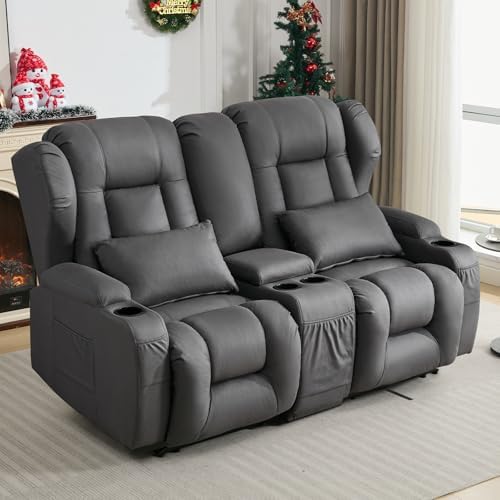
For a massage option, see our full review of the TUNYI Power Loveseat.
The rest of our movie room chair guides
- Choosing the Best Home Theater Seating for Large Families
- Relaxing in an RV or Van with Loveseat Recliners Under $1000
- Best Home Theater Seating for Gaming
- Power Recliners with Massage and Heat Compared
- Choosing the Best Space-Saving Home Theater Seating
- The Home Theater Seating That Work Best for RVs