

Ebservant is reader-supported: some links on this page are affiliate links, and as an Amazon Associate Ebservant earns from qualifying purchases at no extra cost to you. Learn more.
Weight capacity for home theater seating should typically range from 300 lbs to 400 lbs depending on the user’s requirements. You should select a chair that exceeds the weight of the heaviest person who will use it by at least 50 lbs to ensure long-term structural integrity.
Recommended Weight Capacity for Home Theater Seating
| Use Case | Recommended Weight Capacity | Why this number |
|---|---|---|
| Standard Adult Use | 300 lbs | Supports a 300 lb adult for a long movie. |
| Heavy Duty Use | 350 lbs | Supports a 350 lb adult for a long movie. |
| Extra Heavy Duty | 400 lbs | Supports a 400 lb adult for a long movie. |
| Commercial/Public Use | 500+ lbs | Required for high-cycle durability in public settings. |
Home Theater Seats we have reviewed in detail
Each of the 3 shown here has its own full review on this site; they run from $371.44 to $2999.
If you want a premium feel, explore the best luxury leather home theater seats available.
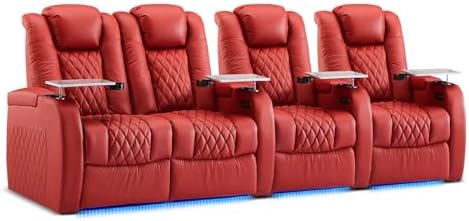
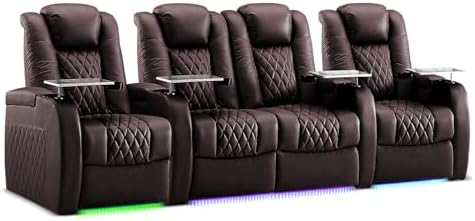

What happens if you go under or overbuy home theater seating?
Going under the required weight capacity for home theater seating leads to rapid structural fatigue. If the weight of a user exceeds the design limit, the frame may experience torque or structural flex, which causes the chair to creak or sag over time. In severe cases, low-density foam will suffer from a foam compression set, where the cushion loses its shape permanently and feels “bottomed-out” after only a few uses. Choosing a chair with insufficient capacity often results in a product that requires replacement within months rather than years.
For those with a lot of guests, see our guide on top home theater seating for large families.
How overbuying home theater seat weight capacity increases product cost
Overbuying weight capacity involves paying for a structural rating that exceeds your actual needs. While a chair rated for 500 lbs will certainly hold a 250 lb person, the manufacturer often achieves higher weight ratings by using thicker, heavier steel frames and denser, heavier high-resiliency foams. These materials increase the total weight of the chair and the cost of the unit. If you do not need to support a 400 lb occupant, you may be paying a premium for heavy-duty hardware that provides no functional benefit to your experience.
Make sure you are comfortable by learning how to choose your recline angle for home theater seats.
The mistake most buyers make with Weight Capacity
The most common mistake with weight capacity is assuming that a high weight rating automatically equates to a comfortable seating experience. A chair might be engineered to support 500 lbs by using a massive steel frame, but if it uses low-density foam to save on costs, the seat will still feel soft and lose its shape quickly. Weight capacity is a measure of structural safety, not a measure of cushioning quality or comfort.
Check out the specific features in our full Tuscany 2025 Recliner review.
Why foam density and seat depth matter more than weight limits
You should optimize for foam density and seat depth instead of just the maximum load. High-density foam ensures that the seat retains its shape over hundreds of cycles, while proper seat depth ensures that your legs and back are supported in a way that prevents fatigue. A chair that supports 400 lbs but lacks proper foam density will eventually feel like sitting on a flat board, regardless of how much weight the frame can technically hold.
View a detailed breakdown of the Valencia Tuscany full review.
How Weight Capacity interacts with other home theater seating specs
Weight capacity for home theater seating interacts with seat width and total depth to determine the actual footprint of the chair. A chair with a high weight capacity often requires a wider base or a deeper frame to distribute that weight across the floor. If you have a small room, a chair with a 400 lb capacity might have a total depth that exceeds your available floor space, making it impossible to place correctly.
See the configuration details in our Tuscany Fila de 3 review.
Matching motor torque to the weight of home cinema seats
Another critical interaction is between weight capacity and the power output of motorized components. In theater recliners, the motors must move the weight of the chair and the occupant. If you select a chair with a very high weight capacity but the motor is only rated for standard loads, the recline may be slow, jerky, or fail to reach the full position. You must ensure the motor torque is compatible with the maximum weight you intend to support. Selecting a chair where the weight capacity exceeds the motor’s capabilities can lead to stalled recline positions or unresponsive buttons.
Get the full technical details in our Valencia Tuscany Recliner spec breakdown.
Selecting a home theater seat weight limit that matches your needs
The way weight capacity works is like a bridge’s weight limit; a bridge rated for 10 tons can carry a 2-ton car easily, but it doesn’t mean the bridge is “better” for a car than a bridge rated for 5 tons. If you choose a chair that falls below your requirements, you risk a permanent loss of money as the chair becomes unusable due to structural sagging or foam failure. By selecting a chair that matches your specific needs based on the data provided, you ensure the furniture remains functional for the duration of its lifespan.
The rest of our movie room chair guides
- Choosing the Best Home Theater Seating for Large Families
- Relaxing in an RV or Van with Loveseat Recliners Under $1000
- Best Home Theater Seating for Gaming
- Power Recliners with Massage and Heat Compared
- Choosing the Best Space-Saving Home Theater Seating
- The Home Theater Seating That Work Best for RVs