

Ebservant is reader-supported: some links on this page are affiliate links, and as an Amazon Associate Ebservant earns from qualifying purchases at no extra cost to you. Learn more.
Total depth for home theater seating is the measurement from the front of the base to the back of the chair. This dimension depends on the available floor space and the specific clearance required for the reclining mechanism to function without hitting walls or other furniture.
If you prefer premium materials, see our guide to the best luxury leather home theater seats.
Which Total Depth Suits Your Space?
| If this is you | The Total Depth that suits you | Why |
|---|---|---|
| You have a small room or a tight alcove | 34 in to 36 in | A shorter footprint allows for more walkway space and prevents the chair from protruding into high-traffic areas. |
| You have a standard-sized media room | 37 in | This is the median depth found in the research and provides a balance between seating volume and floor space. |
| You have a large room with deep seating needs | 38 in to 38.5 in | A larger depth offers a more substantial presence and is common in models with extended footrests or wider bases. |
| You are placing chairs against a wall | 34 in to 38.5 in | The specific depth depends on the recline arc; you must ensure the chair has enough clearance to move backward or forward. |
Products in this category with a full review here
3 options shown here, $859.99 to $2999, each with its own full review behind its name.
Players looking for ergonomic support should view our top picks for gaming home theater seating.

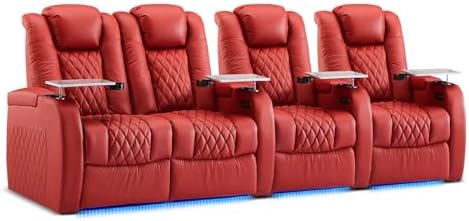
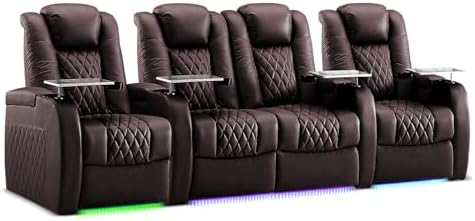
How to Measure Your Space for Home Theater Seating
Measuring your available floor space is the first step to ensuring a chair fits the room. Clear the area where the chairs will sit and use a tape measure to find the distance from the wall or obstacle to the point where the chair will stop.
For those who need a workspace, look at the best home theater seating with tray table features.
Measuring the reclining movement dead zone for theater recliners
Identify the “dead zone” for the reclining movement. Most theater recliners require extra space behind the chair to operate the tilt mechanism. If you are placing the chair against a wall, you must measure the depth of the chair in its fully reclined position, not just its upright state.
Understanding your personal comfort is easier when you learn about the ideal recline angle for home theater seats.
Finding total depth figures in home theater seating specifications
Check the manufacturer’s listing for the “Total Depth” or “Overall Depth” figure. This is usually found in the technical specifications section of the product page. In our research of 24 home theater seating options, the stated total depth figures ranged from 34 in to 38.5 in, with a median of 37 in.
To ensure a comfortable fit, explore how to choose the right seat width for home theater seats.
Using painter’s tape to visualize the theater chair footprint
Mark the floor with painter’s tape to visualize the footprint. Place the tape at the front of where the base will sit and extend it back to your wall or the nearest piece of furniture. This physical boundary helps confirm that the chair will not block pathways or doors when in use.
You can find a clear breakdown of what home theater seats cost at every price level.
What Happens if the Total Depth is Wrong?
Choosing a total depth that is too large for the room results in a cramped environment where the chair may block walkways or prevent doors from opening fully. This mistake often forces a layout change or the removal of other furniture to accommodate the chair’s footprint.
Beginners can start by viewing the different types of home theater seats explained.
For a foundational understanding, see how a home theater seat works and its basic functions.
How measuring only the upright position causes mechanical stalls
A common error occurs when a buyer measures only the chair in its upright position. Because theater recliners move, the chair requires a dynamic footprint. If the chair is placed too close to a wall, the reclining mechanism may hit the surface, causing a mechanical stall or structural stress on the frame.
To understand the technical data, browse our guide to home theater seat terms and specs.
What to Do if You Fall Between Two Total Depths?
When your available space falls between two standard measurements, such as 36 in and 38 in, you should prioritize the smaller depth. It is easier to add space to a room than it is to remove a physical footprint from a finished floor plan.
You can view our full spec breakdown of the Weilianda Zero Gravity Recliner.
Clearance requirements for wall-hugger and standard reclining motions
Consider the clearance required for the specific reclining motion. If the chair has a “wall-hugger” design, it may require less clearance than a standard model. Check if the chair’s mechanism allows it to stay relatively stationary while the seat tilts, as this changes how much depth you need to clear.
For more details on this specific set, see our full review of the ANJ Overstuffed Manual Recliner.
If you are unsure, choose the smaller depth and ensure there is at least 4 in to 6 in of clearance behind the chair for the mechanism to travel. This buffer prevents the chair from feeling cramped against the wall while still maintaining a compact footprint in the room.
For a premium leather experience, look at our full review of the Seatcraft Anthem Loveseat.
Avoiding logistical hurdles by selecting the correct chair depth
The cost of choosing the wrong depth is a chair that cannot be fully reclined or a room that feels inaccessible. If the chair is too deep for the space, you may have to return the item or move other furniture, which can be a significant logistical hurdle. By measuring the clearance and selecting a depth that fits your specific floor plan, you ensure the chair functions as intended without interfering with the room’s layout.
Travelers can see our full review of the Charles RV Recliner for a closer look.