

Ebservant is reader-supported: some links on this page are affiliate links, and as an Amazon Associate Ebservant earns from qualifying purchases at no extra cost to you. Learn more.
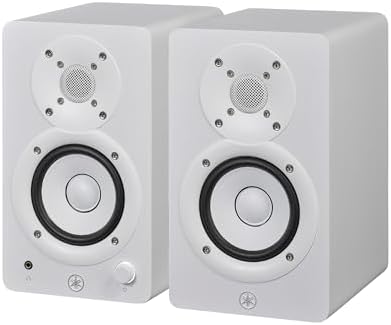
Yamaha HS3 Powered Studio Monitor White
The Yamaha HS3 outputs 26 W of power, so it suits you if you need a compact monitor for a small workspace.
26 W + 26 W power output
- Power Output
- 26 W + 26 W
- Driver Diameter
- 3.5″
- Frequency Response
- 70 Hz – 22 kHz
4.7/5 from 2,273 buyers
- Average buyer rating
- 4.7 out of 5
- Ratings behind it
- 2,273
- What that supports
- A large enough sample to read as a real buyer signal
- Where it comes from
- The product listing, read 9 November 2026
1 deciding spec not stated
- Total Harmonic Distortion
- Not stated in the listing – confirm with the seller before ordering
Suits podcast creators in small bedrooms
- Podcast creators in small bedrooms
- Bedroom music producers
- Content creators filming TikToks
- Desktop gamers
Where the Yamaha HS3 Fits
Yamaha HS3 Powered Studio Monitor produces 26 W + 26 W of output power for users needing a desktop-sized active speaker set.
High-fidelity audio for a desktop setup requires a balance of clarity and size, which the Yamaha HS3 achieves with its 3.5″ cone woofer. This setup allows for a dedicated monitoring space where the 70 Hz – 22 kHz frequency response provides clear detail for vocal and instrumental work.
The Yamaha HS3 is a 2-way bass-reflex powered speaker that delivers 26 W + 26 W of output power. It is a practical choice for users who need a pair of monitors that provide consistent output for near-field listening.
We selected this model from 124 powered speaker systems because it was one of the most-rated products that passed screening, holding the 14th most buyer ratings at 2,273. Our full review focuses on the specs of the 15 chosen models for those looking to upgrade their current desktop setup.
How EB Servant picked: we started from the 200 most-reviewed powered speaker system listings in our retail dataset, removed duplicates, accessories and off-category products, and 124 qualified. This product is one of 15 from that pool chosen for a full review. Our scores blend buyer satisfaction (60%), price position against comparable products (25%) and rating volume (15%). Specifications come from manufacturer listings and ratings from verified Amazon buyer reviews (data checked November 2026).
The Short Answer on the Yamaha HS3
Best for: you need a compact studio monitor for a desk setup where you do not require deep low-end reproduction.
The Yamaha HS3 is a practical choice for a desktop workspace at $388.99.
- Pro: The 3.5″ cone woofer provides a compact footprint for space-constrained desks.
- Pro: A 4.7 rating from 2,273 buyers indicates a consistent experience for home studio users.
- Con: The 70 Hz frequency response means it cannot reproduce the deep bass required for professional studio mixing.
- Con: 26 W of power is insufficient for high-volume needs like backyard parties or fitness classes.
Don’t buy this if: you require a speaker that reproduces frequencies below 70 Hz for low-end studio work.
Price assessment: The $388.99 price point is fair for a pair of 2-way bass-reflex powered speakers with these specifications.
EB Servant score: 7.3/10 (data-driven – see “How we picked” above)
For a more compact setup, read our spec breakdown of the M-AUDIO BX4.
The Specifications That Matter
| Power Output | 26 W + 26 W |
| Driver Diameter | 3.5″ |
| Frequency Response | 70 Hz – 22 kHz |
| Included Accessories | No |
| Pair | 2 |
| Tweeter | 0.75″ dome tweeter |
| Woofer | 3.5″ cone woofer |
The 3.5″ driver diameter measures the physical width of the speaker cone or diaphragm.
Before You Buy: Powered Speaker System Checklist
The first thing to check is your intended use for the output power, as the 26 W + 26 W rating determines the maximum electrical energy the amplifier can provide to the speakers.
- ✅ Confirm your need for low-end frequencies — the 70 Hz frequency response is not low enough for professional studio work requiring a lowest setting of 60 Hz or lower.
- ✅ Measure your available desk surface — the 3.5″ driver diameter indicates a compact footprint suitable for tight desktop setups.
- ✅ Verify your volume requirements — the 26 W output is not enough for high-volume sound in a beach trip or backyard party where 200 to 500W is needed.
- ✅ Check your connection type — ensure your cables match the intended signal integrity to avoid an impedance mismatch, which can cause overheating or reduced power output.
- ✅ Budget for a pair — the Yamaha HS3 is sold as a pair, and the 2 ($194.50 per speaker) configuration provides the necessary stereo setup.
- ✅ Monitor your signal levels — avoid pushing the speakers beyond their headroom to prevent clipping and distortion, which causes permanent hardware damage and harsh audio.
You should not buy this product if you need to reproduce deep bass for a mobile DJ set or provide high-volume sound for a fitness class, as the 26 W output and 3.5″ driver do not meet those requirements.
Performance: What the Specs Deliver
How the 70 Hz to 22 kHz frequency range performs
The Yamaha HS3 provides a 70 Hz – 22 kHz frequency response, which defines the audible pitch range the speaker can reproduce. Because the lower limit is 70 Hz, you will need to pair these with a subwoofer if your work requires deep, sub-bass frequencies that drop below that threshold. This range is sufficient for high-fidelity audio on a desktop setup, where most mid-range and high-frequency detail resides.
The 70 Hz limit means the Yamaha HS3 is not intended to reproduce the lowest notes of a kick drum or a deep synth bass, which often require a driver significantly larger than the 3.5″ cone woofer. While it handles the majority of a music track’s clarity, you should expect the low end to roll off as it approaches that bottom limit. This makes the speaker a focused choice for monitoring vocals and instruments where high-frequency accuracy is a priority over extreme low-end extension.
Room and High Trim Controls
You can adjust the sound to be less bright or harsh using the high trim response control, which allows you to manage the intensity of the upper frequencies. This control helps reduce ear fatigue during long mixing sessions by smoothing out the sharpest peaks in the audio. The Yamaha HS3 also includes room control to help manage how the speaker interacts with your specific environment.
The high trim response control works by letting you dial back the treble, which is useful if your room has many hard surfaces that reflect high-frequency sounds. By tailoring the output to your space, you can ensure the monitor provides a balanced sound without becoming piercing. These controls allow you to customize the 26 W + 26 W output to suit your personal listening preference or the specific acoustic layout of your room.
The Yamaha HS3 Job by Job: What Its Figures Cover
The Yamaha HS3 against the jobs buyers ask about, worked out from its listed frequency response and driver diameter and power output and a typical need for each job.
| Job | What it takes | Yamaha HS3 |
|---|---|---|
| Provide high-fidelity audio for a desktop setup | no more than 50 to 20,000Hz | Only at the easier end of that range – 70Hz |
| Reproduce low-end frequencies for studio work | a lowest setting of no more than 60Hz | No – goes down to 70Hz |
| Provide deep bass for a mobile DJ set | at least 10 to 12in | No – 3.5in |
| Provide high-volume sound for a beach trip | at least 50 to 150W | No – 26W |
| Provide clear audio for a tailgating event | at least 50 to 150W | No – 26W |
How the Yamaha HS3 Compares to Other Active Speaker Sets
The Yamaha HS3 provides the largest frequency response range of the options we evaluated, reaching 70 Hz to 22 kHz.
- The Yamaha HS3 matches the Yamaha HS8 Studio Monitor at the $388.99 price point.
- The TONOR Wireless Karaoke Machine offers a wider 30Hz-20kHz range compared to the Yamaha HS3.
- The ALTO TX315 700W Powered DJ Speaker provides 700 Watts of power, which is larger than the 26 W + 26 W output of the Yamaha HS3.
- The No JBL 305P MkII 5-Inch Active Studio Monitors features a 5-inch woofer, which is larger than the 3.5″ cone woofer on the Yamaha HS3.
If you require deep bass for a mobile DJ set or a backyard party, the ALTO TX315 700W Powered DJ Speaker is the better choice due to its 700-Watt power output.
What the deciding spec costs here: Measured as price per unit of Driver Diameter, the reviewed product works out to $111.14 against a $26.82 median across the 104 other screened products that state the spec, and 100 of them deliver more of it per dollar. The cheapest screened product that beats its 3.5″ is the No PPHP1244B at $100.99 with 12″, which is $288 less than this one for more of the spec that decides this category.
If you are looking for a different brand, see our full review of the Mackie CR4-XBT.
How this Powered Speaker System compares to average market pricing
The Yamaha HS3 sits $1 above the $388 average for the similar powered speaker system products we compared it against. While the price point is near the middle of the field, the 26 W + 26 W output power means you are trading the high-volume capabilities of larger systems for a compact footprint that fits a desktop setup. You get a 3.5″ cone woofer and a 0.75″ dome tweeter, but you give up the ability to provide deep bass for studio work or high-volume sound for a backyard party.
This powered speaker system is the right buy if your priority is a compact footprint for near-field listening where you do not need to reproduce low-end frequencies below 70 Hz. If you require a system that can provide clear audio for a fitness class or a backyard party, the 26 W output is not enough for those jobs.
Where this sits in the buyer data: Among the 124 products screened for this category, this one’s 4.7 rating places it #3, on 2,273 ratings – above the 499-rating median of that group, so the average rests on more feedback than most of its comparables. On price it undercuts 15 of them.
From Delivery to First Use with This Active Speaker Set
Setting up the Yamaha HS3
You need a standard AC power outlet to operate the Yamaha HS3 before you can begin the setup.
- Unpack the speaker and place it on a stable surface or a speaker stand to elevate the 3.5″ woofer to ear level.
- Connect the power cord to the rear of the unit and plug it into a wall outlet.
- Connect your audio source to the input using an XLR cable, which provides a balanced connection for long cable runs.
- Adjust the high trim response control and room control on the back panel to calibrate the sound for your specific space.
Verifying warranty coverage and power requirements for this active speaker set
Warranty coverage and support terms differ by seller and country.
- Confirm the power requirements and voltage on the rear plate to ensure the unit matches your local electrical grid.
- Verify the input connector types to ensure your cables fit the ports without forcing the pins.
- Check the speaker’s physical dimensions against your available space to ensure the 3.5″ cone woofer has proper clearance.
Test the Yamaha HS3 at a moderate volume level the day it arrives to ensure the 26 W + 26 W output meets your expectations before the return window closes.
The Yamaha HS3: Remaining Questions
How does the Yamaha HS3 perform for a desktop studio?
The Yamaha HS3 provides high-fidelity audio for a desktop setup because it covers the necessary range up to 20,000Hz. While the 70 Hz frequency response is on the easier end of the spectrum, it is sufficient for most near-field monitoring tasks.
Can the Yamaha HS3 reproduce deep bass for studio work?
No, the Yamaha HS3 does not provide deep bass for professional studio work as it only reaches 70 Hz. For projects requiring a lower limit of 60 Hz or less, this speaker does not provide the necessary low-end response.
Is the Yamaha HS3 suitable for a mobile DJ set?
The Yamaha HS3 is not suitable for a mobile DJ set because it uses a 3.5″ cone woofer. To provide deep bass for a mobile setup, you would typically need a driver measuring at least 10 to 12 inches.
What is the power output of the Yamaha HS3?
The Yamaha HS3 features a power output of 26 W + 26 W. This level of power is intended for near-field use and does not provide the 200 to 500W required to play music for a backyard party.
Is the Yamaha HS3 Right for You?
Who the Yamaha HS3 suits and the jobs it is the wrong choice for, listed below with the reason for each.
Who this powered speaker system is for, and what it does well
Who the Yamaha HS3 suits
- Podcast creators in small bedrooms — the 26 W output and 3.5″ woofer provide clear vocal clarity without overwhelming a tiny space
- Bedroom music producers — the high trim response control allows for precise monitoring of high-frequency details in a home studio
- Content creators filming TikToks — the 2-way bass-reflex design ensures balanced audio for mobile video editing
- Desktop gamers — the compact 3.5″ driver diameter fits easily on a crowded desk while providing dedicated studio monitoring
- Audio engineering students — the room control and high trim response controls allow for learning how to calibrate sound to a specific environment
What this active speaker set handles well
- Vocal recording and mixing — the 0.75″ dome tweeter provides crisp high-frequency detail
- Desktop audio monitoring — the 3.5″ cone woofer provides a compact footprint for tight workspaces
- Near-field mixing — the 26 W + 26 W output power is optimized for close-range listening
- Room-specific tuning — the room control and high trim response controls allow for acoustic adjustments
- Podcast production — the 70 Hz – 22 kHz frequency response captures a wide range of human speech frequencies
What this self-powered speaker is the wrong choice for
- Club DJing or large venue playback — the 26 W + 26 W output power is insufficient for high-volume public spaces
- Sub-bass heavy electronic music production — the 70 Hz lower limit means deep sub-frequencies will be missing
- Large hall monitoring — the 3.5″ driver diameter is too small to move enough air for large rooms
- Live concert monitoring — the 2-way bass-reflex design lacks the power and scale for stage use
What to budget alongside this powered speaker system, and what to skip
Accessories worth buying with the Yamaha HS3
- XLR or TRS cables — required to connect the powered speakers to an audio interface or mixer
- Studio monitor isolation pads — necessary to decouple the 3.5″ woofer from the desk to prevent vibration
- Audio interface — required to input signals into the powered speaker system
- Speaker stands — needed to position the 3.5″ drivers at ear level for accurate monitoring
- Acoustic foam panels — needed to manage the room’s response since the speakers are designed for near-field use
Accessories you can skip buying for this powered speaker system
- External power amplifier — the speakers are already powered with 26 W + 26 W output
- Separate woofer — the 2-way bass-reflex design handles the low end within the unit
- High-wattage power supply — the internal power system is already integrated into the speaker
You can also browse the best studio monitors for music production to find your perfect match.
Where to Buy This Powered Speaker System
When we looked in November 2026, the Yamaha HS3 was listed at $388.99 – a snapshot that may have changed since.
Powered speaker systems are sold by the retailers below – we do not track which of them has the Yamaha HS3 in stock, so check availability and the current price with the retailer before making a trip.
- Sweetwater (online only) — specialist staff and trade accounts
- Guitar Center (online and physical stores) — in-store returns and physical testing
- B&H Photo Video (online only) — specialist staff and fast shipping
- Best Buy (online and physical stores) — in-store returns and physical testing
- Crutchfield (online only) — specialist staff and audio expertise
- Amazon (online only) — breadth of range
Final Verdict on the Yamaha HS3
If you need a compact powered speaker system for a desktop setup that provides clear audio for near-field listening, the Yamaha HS3 is a practical choice at around $388.99. It delivers 26 W + 26 W of output power, which is sufficient for a small workspace but lacks the wattage required for high-volume environments like a fitness class or a backyard party.
The Yamaha HS3 ranked first on the 4.7 rating from 2273 buyer ratings among the powered speaker systems we evaluated. This high volume of buyer feedback provides a significant signal regarding the product’s performance in home environments.
Skip it if: you need to reproduce low-end frequencies for professional studio work, as the 70 Hz – 22 kHz frequency response is not low enough, or if you require deep bass for a mobile DJ set where a 3.5″ cone woofer lacks the necessary diameter.
Warranty details: see the official Yamaha warranty page.
More self-powered speaker explainers and comparisons
- Best Powered Speaker Systems for Small Venues Under $400
- Playing Loud Music for a Backyard Party With a Powered Speaker System
- Which Powered Speaker System Works Best for an Outdoor Fitness Class?
- The Powered Speaker Systems That Work Best for a Beach Trip
- The Powered Speaker Systems That Work Best for Karaoke
- Which Studio Monitors Are Best for Music Production?