

Ebservant is reader-supported: some links on this page are affiliate links, and as an Amazon Associate Ebservant earns from qualifying purchases at no extra cost to you. Learn more.
Bit depth for a mixing console should be 24 bits for most professional and high-quality home recording applications. You need 24 bits if you intend to process audio with a high dynamic range or want to ensure that the noise floor remains below the threshold of human hearing during complex mixing tasks.
Remote control options are expanding, so see the best digital mixer for tablet control for a wireless setup.
Recommended Bit Depth Values for Mixing Consoles
| Use Case | Recommended Bit Depth | Why this number |
|---|---|---|
| Basic podcasting or voiceover | 16 bits | 16 bits provides a 96 dB dynamic range, which covers the requirements for standard speech and single-track recording. |
| Home music production | 24 bits | 24 bits provides a 144 dB dynamic range, allowing for significant headroom during the creative mixing process. |
| Professional studio mixing | 24 bits | 24 bits is the industry standard for high-fidelity audio, ensuring that the signal-to-noise ratio remains high across all tracks. |
| High dynamic range processing | 24 bits | At least 24 bits is required to maintain signal integrity when applying heavy compression or complex spatial effects. |
| Extreme high-fidelity archival | 32 bits | 32 bits provides a theoretical 192 dB of dynamic range, useful for avoiding rounding errors in massive multi-track projects. |
Mixing Consoles covered by our own reviews
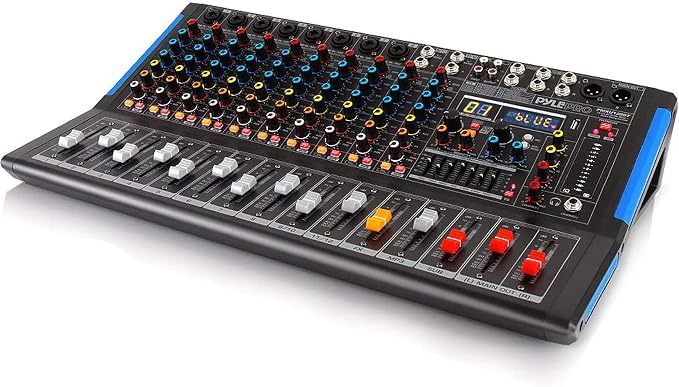
Each of the 3 shown here has its own full review on this site; they run from $139 to $214.99.
For high-end processing in a small footprint, look at the best compact mixer with lexicon effects.


What happens if you go under or overbuy on Bit Depth?
Going under the recommended 24-bit threshold for a mixing console typically results in a higher noise floor. If you choose a 16-bit system, you have a 96 dB dynamic range. This means that as you lower the fader or reduce the gain, the inherent electronic hiss of the system will appear sooner in the audio. For a simple podcast, this is rarely an issue. However, in a musical context where you need to keep quiet passages clean while maintaining the ability to have loud peaks, 16 bits can limit your creative choices and force you to “pre-mix” at higher volumes to stay above the noise.
Portability is key for live gigs, so find the best bluetooth audio mixer for mobile use for your next event.
Why 32-bit mixing consoles offer diminishing returns for human hearing
Overbuying on bit depth involves moving into 32-bit or higher ranges. Many users assume that more bits translate directly to “better” sound quality in every scenario. In reality, the human ear cannot distinguish between 24-bit and 32-bit audio in a standard listening environment. The extra bits provide a massive theoretical dynamic range that most hardware and software components cannot actually utilize. If you spend extra money to move from a high-quality 24-bit mixing console to a 32-bit system, you are paying for a safety net of headroom that you will likely never use. It is a cost for precision that does not yield a perceptible change in the final output for most users.
Space is often limited at home, so find the best small audio mixer for home studio configurations.
What is the most common mistake with Bit Depth?
The most common mistake buyers make is prioritizing bit depth over sampling rate or conversion quality. While bit depth determines the dynamic range—the distance between the quietest and loudest possible sounds—the sampling rate determines the frequency range. A high bit depth on a low-quality internal converter will still result in a muddy or “thin” sound. If the internal Digital-to-Analog Converters (DACs) are poorly designed, the extra bits are essentially just describing a low-quality signal with more precision.
Ensure you have enough routing options by viewing how many outputs for mixing consoles you actually need.
Why high-quality components matter more than 32-bit mixing console depth
You should optimize for the quality of the components that handle the actual conversion. A 24-bit mixing console with high-quality components will always outperform a 32-bit console with budget components. Focus on the brand of the converters and the quality of the preamps. These physical components dictate how the signal feels and moves, while bit depth simply sets the mathematical ceiling for the data. If you have a choice between a 24-bit console with great reviews and a 32-bit console with generic components, the 24-bit option is the practical choice.
Budgeting is the first step in any purchase, so see what mixing consoles cost at every price level.
Understanding your hardware is easier when you see the different types of mixing consoles explained in detail.
How does Bit Depth interact with other mixing console specs?
Bit depth interacts directly with the signal-to-noise ratio of the mixing console‘s internal circuitry. Because bit depth defines the dynamic range, it works in tandem with the noise floor of the preamps. If a mixing console has a high noise floor, a high bit depth cannot “fix” the hiss; it only means the hiss is represented in the digital file more accurately. You want a balance where the bit depth is high enough to provide headroom, but the hardware is quiet enough that the noise floor stays buried.
For a deep dive into that specific model, see our full Rockville RPM45 spec breakdown.
How mixing console input counts determine project scale over bit depth
Another critical interaction is between bit depth and the number of inputs. In large-scale mixing, as you add more inputs and tracks, the risk of digital clipping or rounding errors increases. A 24-bit depth provides a stable environment for these calculations. However, the total number of inputs is the physical limit of your project. You can have a 99-bit mixing console, but if it only has 4 inputs, you cannot record a full band. The bit depth ensures the quality of the signals you do have, but the input count determines the scale of the project you can manage.
You can find technical details in our full AMX7333 Mixer review to see if it fits your needs.
Why mixing table meter resolution differs from internal bit depth
Finally, bit depth is often confused with the resolution of the meters on the mixing table. While the internal processing might be 24-bit, the visual meters might only show 16-bit increments. This is a common occurrence in many mixing desks. The internal processing remains high-fidelity, while the visual representation is simplified for ease of use. You do not need the meters to match the internal bit depth to achieve a high-quality mix. The data processed by the internal engine is what matters for the final output.
For a closer look at its features, view our full AMX7332 Mixer review for more data.
Why 24-bit depth serves as the professional baseline for signal chains
When choosing your requirements, consider the complexity of your signal chain. If you are using many plugins that perform heavy mathematical transformations, 24 bits is the baseline to ensure those calculations don’t degrade the audio. If you are doing simple live mixing where the volume stays relatively consistent, you can get away with lower specifications more easily. Always look for the 24-bit mark as your target for a professional result.
We provide a detailed analysis in our full Notepad-12FX review for those seeking more information.