

Ebservant is reader-supported: some links on this page are affiliate links, and as an Amazon Associate Ebservant earns from qualifying purchases at no extra cost to you. Learn more.
Power output for a mixing console should range from 500 Watts to 6,000 Watts depending on the specific requirements of the sound system being driven. You need at least 500 Watts to power a large PA system for a small venue, while larger installations may require the upper end of that range to maintain headroom during peak signals.
Recommended Power Output Values for Mixing Consoles
| Use Case | Recommended Power Output | Why this number |
|---|---|---|
| Small home studio or bedroom setup | 50 to 100 Watts | Small monitors or active speakers typically draw very low power, making high wattage unnecessary. |
| Small venue or cafe live sound | 500 to 1,000 Watts | This range provides enough power to drive a standard PA system for a small space without clipping. |
| Mid-sized club or house of worship | 1,000 to 3,000 Watts | Larger arrays require more energy to maintain clarity at higher volumes without distorting the signal. |
| Large scale touring or stadium use | 3,000 to 6,000 Watts | High-wattage requirements ensure the system can handle massive transient peaks across large distances. |
Mixing Consoles we have reviewed in detail
From $186.89 to $238.90: 3 of the 15 in this category we have reviewed in full.
If you are just starting out, see our list of the best mixing console for beginners.


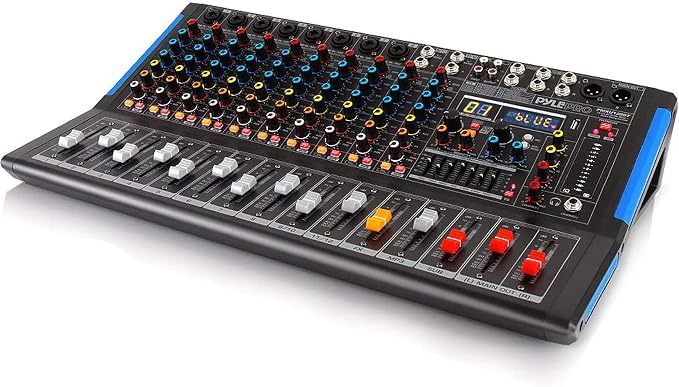
What happens if you under-buy or over-buy power?
When the console lacks the wattage to drive the connected load, the signal peaks are “shaved off” as the hardware reaches its physical limit. This results in a harsh, crunchy sound that can damage speakers if sustained at high volumes. If you are running a live set, under-powered hardware will struggle to maintain a consistent volume, forcing you to push the preamps into a range where noise floors rise and clarity drops.
Why over-buying mixing console power output wastes budget and creates heat
Over-buying power output results in unnecessary costs and increased heat generation. While having extra wattage provides a safety net for headroom, a mixing console that outputs 6,000 Watts when your speakers only require 500 Watts is an inefficient use of budget. Excess power in the internal circuitry generates heat, which can lead to thermal throttling or a shorter lifespan for internal components. If you are building a home studio, paying for thousands of Watts of overhead provides no audible benefit because your physical room volume limits how loud you can play before the sound becomes unusable.
For a specific budget option, see our full Pyle PMXU88BT Mixer review.
The mistake most buyers make with mixing console power
The most common mistake is assuming that a high Wattage figure on a mixing console directly translates to higher volume from the speakers. Power output on a mixing console measures the electrical energy the device can deliver to a load, but it does not dictate the final loudness of the room. Many buyers choose a high-wattage console thinking it will make their system “louder,” when in reality, the volume is limited by the physical size of the speakers and the acoustics of the space.
How mixing console headroom and signal integrity matter more than wattage
Instead of focusing solely on the Wattage, you should optimize for headroom and signal integrity. Headroom is the amount of “space” available in the signal path before it hits the clipping point. A console with a well-designed power stage provides a clean, undistorted signal even when the input levels are high. To determine your needs, count the number of active speakers you plan to drive and check their maximum power rating. If your speakers are rated for 500 Watts each, do you need a console that provides that much power to the entire chain? The answer is usually no, as the console’s role is to process the signal, while the power amplifiers in the speakers do the heavy lifting of moving the air.
Another entry-level option is available in our full Pyle PMXU67BT Mixer review.
How power output interacts with other mixing console specs
Power output interacts with the number of inputs and the sampling rate to determine the practical limits of the mixing console. While Watts provide the energy, the number of inputs determines how many individual audio signals can be connected simultaneously. A high-wattage console with only four inputs is useless for a large band, just as a high-input count console with insufficient power will fail to drive a large PA system.
How mixing console power preserves high-frequency detail from high sampling rates
A high sampling rate, such as 48kHz, ensures that the digital snapshots of the audio are frequent enough to capture high-frequency detail. When you have a high-quality digital signal, the power output ensures that this detail is preserved as it moves into the analog stage of the output. If the power supply is weak, the high-resolution data can be degraded by electrical noise or clipping before it reaches the speakers.
Explore the studio capabilities in our full DX12 Audio Mixer review.
Why the output stage wattage determines mixing console performance under heavy loads
In many cases, the power output is limited by the internal power supply’s ability to maintain a steady voltage under load. For example, a mixing console might state a maximum of 1,050 Watts, which is the median figure found in many professional listings. However, if the number of inputs being used simultaneously is high, the internal components may share that power pool. If you are running a complex mix with dozens of active channels, you need to ensure the power supply can sustain the load across all outputs without a drop in voltage. This is why checking the specific Wattage for the output stage is more relevant than the total power consumption of the unit.
What are the limits of power output in mixing consoles?
The limits of power output in a mixing console are defined by the physical components of the internal power supply and the heat dissipation capabilities of the chassis. Even if a manufacturer claims a high Wattage, the actual usable power may be lower during sustained use to prevent the internal components from overheating. This is why it is important to understand what a specific Wattage means for your setup. For instance, if you are trying to drive a large touring rig, will the console provide enough current to maintain a flat frequency response at high volumes? A console with a robust power stage will maintain a steady output, whereas a lower-powered unit might experience a “sag” in the low-end frequencies when pushed to its limit.
For high-power requirements, check out our full RPM80BT Mixer Amplifier review.
Calculating mixing console power requirements for live house of worship peaks
One specific example of this is a live house of worship setup where the system must handle sudden, high-energy peaks from a kick drum or a loud vocal. To handle these peaks, the mixing console needs enough power to deliver the signal instantly without the voltage dropping. If the power supply is insufficient, those peaks will sound muffled or distorted. To check your own requirements, look at the total wattage of your active speakers and divide by the number of speakers in your array. If your total requirement is 2,000 Watts, you should look for a console that can comfortably handle that load without being pushed to its absolute maximum capacity.