

Ebservant is reader-supported: some links on this page are affiliate links, and as an Amazon Associate Ebservant earns from qualifying purchases at no extra cost to you. Learn more.
Driver diameter for a line array loudspeaker refers to the physical width of the speaker cone, measured in inches. You must choose a diameter that aligns with your specific venue size and acoustic requirements rather than simply selecting the largest available number.
Which Driver Diameter Suits Your Venue?
| If this is you | The Driver Diameter that suits you | Why |
|---|---|---|
| You are providing audio for small retail spaces or background music in a cafe. | 3.5 to 6 inch | Smaller diameters allow for compact cabinets that blend into decor while providing clear high-midrange clarity. |
| You need to cover a medium-sized room or a small corporate presentation space. | 8 to 10 inch | This is the median size for many line array systems, balancing sufficient throw with manageable weight. |
| You are setting up a large indoor hall or a medium-sized outdoor festival stage. | 12 to 15 inch | Larger cones move more air, providing the necessary pressure to reach back rows in larger environments. |
| You are designing a large-scale outdoor concert or stadium line array. | 15 to 18 inch | The largest standard diameters provide the maximum physical surface area to produce high-output low-end and mid-range. |
Line Array Loudspeakers covered by our own reviews
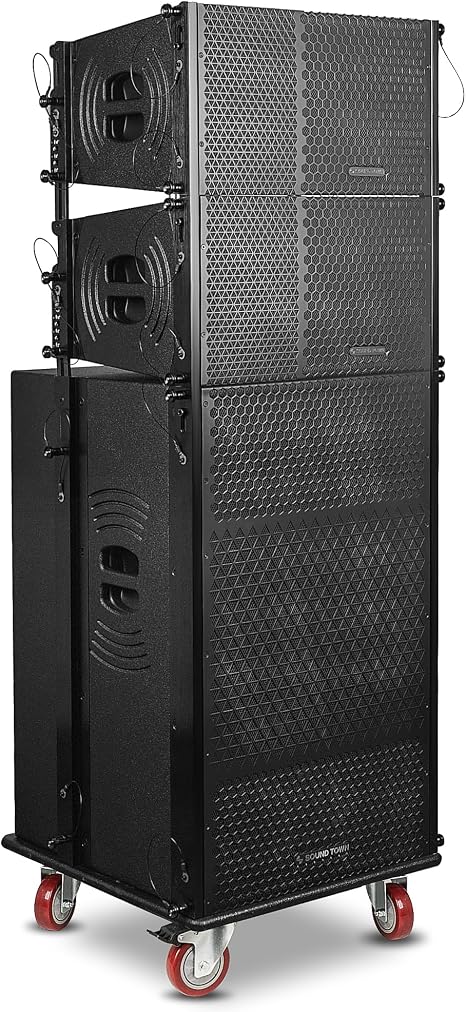
3 options shown here, $449.99 to $2999.99, each with its own full review behind its name.


How do I measure or establish my required Driver Diameter?
To establish your required driver diameter, you must first determine the “throw” distance, which is the distance from the speaker to the furthest listener. You can determine this by measuring the length of your venue from the front of the stage to the back wall. A common way to identify the correct size is to calculate the square footage of your space; larger areas generally require larger drivers to maintain consistent volume.
For houses of worship, see top line array speakers for churches to find the right fit.
Locating the driver diameter on manufacturer data sheets and cabinets
You can find the specific driver diameter on the manufacturer’s technical data sheet or on the physical cabinet itself. Most manufacturers list this as “Woofer Size,” “Driver Diameter,” or “Transducer Size” in inches. If the listing only provides a model number, you must look for the technical specifications to confirm the exact inch measurement. For example, if a listing states “10 inch,” it refers to the physical width of the cone, not the frequency range or the power output.
Selecting line array driver diameters based on maximum throw distance
When evaluating the options we compared, 19 out of 23 line array loudspeaker listings explicitly stated a driver diameter ranging from 3.5 to 18 inches. Because there is no single “best” size, you should identify your maximum throw distance first. If your throw exceeds 50 feet in an open area, you should prioritize diameters at the higher end of the 10 to 18 inch range to ensure the sound maintains its integrity over the distance.
For more details on that specific model, see our full SALA-210 review.
What happens if I choose the wrong Driver Diameter?
Choosing a driver diameter that is too small for your space results in a lack of “throw,” where the sound loses its impact before reaching the back of the room. This often manifests as a “thin” sound where the front rows hear clear audio but the back rows struggle to hear anything but faint high frequencies. Because smaller drivers have less surface area, they cannot physically push enough air to maintain volume over long distances.
Selecting a driver diameter that is too large for a small room can lead to “muddiness” or excessive boominess. In small spaces, the large cones can move so much air that the low-mid frequencies become overwhelming, causing the sound to become blurred or “washy.” This happens because the physical size of the driver produces a high volume of low-frequency energy that the room’s dimensions cannot properly disperse, leading to a cluttered acoustic environment.
If you need a compact solution, look at the Sound Town CARPO-V5B Column Mini Line Array page.
How driver size affects physical installation and cabinet dimensions
A mismatch between driver size and venue size can also lead to physical installation issues. Larger drivers require deeper and wider cabinets, which may not fit on standard mounting brackets or in designated ceiling spaces. If you choose an 18 inch driver for a space that only has room for a 10 inch cabinet, you will be unable to mount the system safely or effectively. Always verify the physical dimensions of the cabinet required by the driver size before making a selection.
What should I do if I fall between two Driver Diameter sizes?
If your requirements fall between two sizes, such as choosing between a 10 inch and a 12 inch driver, you should decide based on your primary priority: weight or throw. A 10 inch driver is generally lighter and easier to hang in a line array, making it better for applications where the distance to the audience is relatively short. If you choose the smaller option, you may need to use more units in the array to achieve the same coverage.
For a premium boutique option, see our full review of the Bose L1 Pro8.
Using larger driver diameters to increase air movement and coverage
If your primary concern is reaching the furthest person in the room, choose the larger diameter. A 12 inch driver provides more surface area to move air, which helps maintain the “body” of the sound over distance. In many cases, choosing the larger diameter allows you to use fewer total cabinets to achieve the same volume, which can simplify the wiring and rigging of the system.
Choosing 10 to 12 inch drivers for versatile mounting requirements
When requirements conflict, such as needing high output but having limited mounting space, the 10 inch to 12 inch range is often the most versatile. These sizes provide a balance that works in a variety of environments. If you are unsure, evaluate the weight limits of your mounting points. If your rig can support the heavier 12 inch cabinets, they offer a more versatile range for future larger events. If your rig is limited, the 10 inch driver provides a reliable middle ground for most indoor applications.
The other line array guides we have published
- Which Powered Column Line Array Speaker System Is Best for Solo Musicians?
- Best Line Array Speakers for Church and Conferences
- Line Array Speaker Systems for DJ and Clubs Compared
- Choosing the Best Portable Line Array Speaker System with Bluetooth
- The Passive Line Array Speakers That Work Best for Live Sound
- Which Line Array Speaker System with Subwoofers Is Best?