

Ebservant is reader-supported: some links on this page are affiliate links, and as an Amazon Associate Ebservant earns from qualifying purchases at no extra cost to you. Learn more.
SPL (Maximum Sound Pressure Level) for line array loudspeakers typically ranges from 130 dB to 140 dB depending on the specific application. You need a system that provides a 3 dB to 6 dB buffer above your required peak level to account for distance, environmental acoustics, and safety margins.
Recommended SPL (Maximum Sound Pressure Level) by Use Case
| Use Case | Recommended SPL (Maximum Sound Pressure Level) | Why this number |
|---|---|---|
| Small Indoor Venues | 120 dB – 126 dB | Provides sufficient clarity for 50-150 people without causing acoustic fatigue. |
| Medium Outdoor Events | 126 dB – 132 dB | Compensates for the lack of reflective surfaces and high ambient noise floors. |
| Large Concert Arenas | 133 dB – 138 dB | Ensures consistent high-impact sound across large distances and high-capacity crowds. |
| Stadiums and Festivals | 138 dB – 142+ dB | Necessary to maintain presence over massive areas and overcome extreme environmental interference. |
Line Array Loudspeakers covered by our own reviews
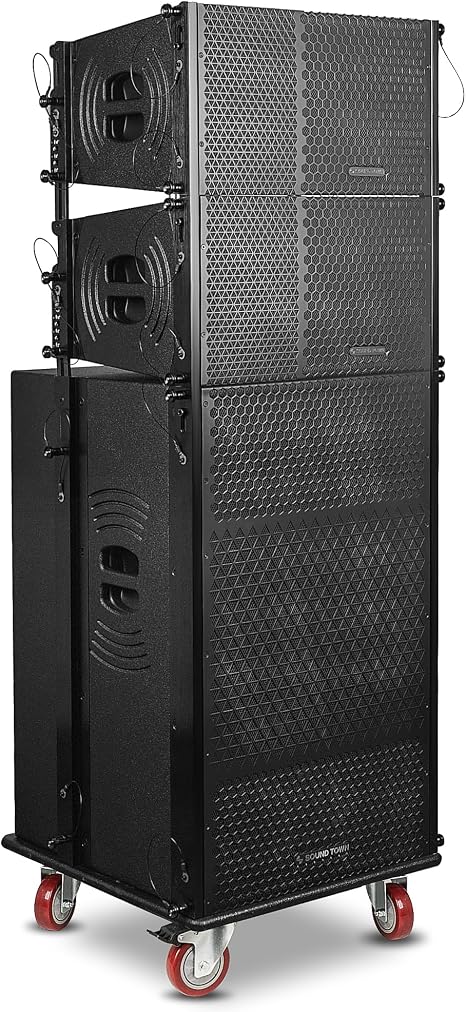
3 options shown here, $387.99 to $2999.99, each with its own full review behind its name.

What Happens if You Underbuy or Overbuy SPL?
The Consequences of Underbuying SPL
Underbuying SPL means selecting a line array loudspeaker that cannot reach the required decibel level for your venue size. If the system lacks sufficient headroom, the audio will sound thin or strained as the amplifiers work near their limits. You may find that the sound does not reach the back of the room with enough clarity to be intelligible. This often forces a compromise where the front rows are uncomfortably loud while the rear remains quiet.
Limited SPL headroom reduces dynamic range and causes audio distortion
A lack of SPL headroom also limits your ability to manage dynamic range. In live sound, if your base volume is already near the hardware’s maximum, there is no room for sudden peaks in the music. This leads to a compressed, flat sound where the impact of the performance is lost. You might also experience distortion as the system struggles to produce the necessary pressure, resulting in a harsh, unpleasant listening experience for the audience.
The Practical Costs of Overbuying SPL
Overbuying SPL involves selecting a system with a maximum output significantly higher than your venue requires. While it seems like a “future-proof” move, a system rated for 145 dB in a space that only needs 120 dB introduces significant costs. The primary cost is physical weight and the complexity of the rigging required to support larger, more powerful cabinets. You may end up paying for a massive infrastructure of power distribution and heavy-duty mounting that your specific use case does not justify.
Overpowered line array systems create safety hazards and mixing difficulties
Overbuying also creates a risk of acoustic damage and safety hazards. A system with excessive power can easily overwhelm a small room, leading to permanent hearing damage for the audience or structural damage to the venue’s surfaces. It also makes the system harder to mix; when a speaker is vastly overpowered for the space, the “sweet spot” for clear audio becomes very small. You spend more on the initial purchase and the transportation of heavy gear for a capability you will never actually utilize.
You can view the detailed technical data in our full ZETHUS ZS-215SP110PX2C review.
The Common Mistake with SPL and What to Optimise Instead
Why Focusing Only on Peak SPL is a Mistake
The most common mistake buyers make is assuming that a high peak SPL figure automatically guarantees a good listening experience. A line array loudspeaker might be capable of 140 dB, but if it lacks the proper dispersion characteristics, that power will only be useful in a very narrow corridor. High SPL is a measure of raw pressure, not how that pressure is distributed across a crowd.
Matching line array coverage angles to venue shape improves sound
You should instead optimize for horizontal and vertical coverage angles. A line array is designed to throw sound forward; if the vertical dispersion is too narrow, the sound will overshoot the audience and hit the ceiling. If the horizontal dispersion is too wide, the sound will bleed into side rooms or cause phase cancellation issues. Look for a system where the coverage pattern matches the shape of your venue. A 130 dB system with a 90-degree horizontal spread is often more useful than a 140 dB system with a 45-degree spread.
Matching Coverage to Venue Geometry
When you choose a system, determine the “throw” distance—the distance from the speakers to the furthest listener. If you have a long, narrow venue, you need a high-output line array with a narrow vertical dispersion to keep the sound on the ground. If you have a wide, shallow space, you need a system with a wider horizontal spread. By prioritizing the coverage pattern over the peak decibel rating, you ensure that the SPL is distributed evenly, providing a consistent experience for every person in the room.
How SPL Interacts with Other Deciding Specs
The Relationship Between Driver Diameter and SPL
Driver diameter is a primary physical factor that influences how much SPL a line array loudspeaker can produce. Larger drivers can move more air, which is the fundamental requirement for generating high sound pressure levels. However, a larger driver does not always mean a higher SPL rating; it often relates to the depth of the frequency response and the ability to move large volumes of air at lower frequencies.
Large driver diameters provide necessary displacement for high SPL bass
If you need high SPL in the low-end frequencies, you must look for larger driver diameters. Smaller drivers may reach high peak levels in the mid-range, but they will struggle to produce the physical displacement needed for deep bass. When evaluating a system, check the driver size to ensure it matches the frequency range you intend to project at high volumes. A system with large woofers will provide a fuller, more physical sound at high SPL than a system relying on smaller transducers.
For a compact solution, view our full review of the Sound Town CARPO-V5B.
Weight and Power Draw as Limits to SPL
The amount of SPL a system can produce is limited by its weight and the power it can draw from your venue’s electrical grid. High-output line array loudspeakers require heavy-duty magnets and large heat sinks to manage the energy required to produce high decibel levels. This results in heavier cabinets that require more robust rigging and more robust power infrastructure.
Venue power supply and weight limits dictate maximum usable SPL
Before selecting a system based on its SPL, verify that your venue can support the weight of the cabinets and the amperage required to drive them. A system that produces 140 dB might require a three-phase power supply that a standard wall outlet cannot provide. If your power is limited, a system with a lower peak SPL but higher efficiency may be the only viable choice. Always match the SPL requirements of your event to the physical and electrical capacities of the location.
Preventing Feedback Loops and Phase Cancellation
High SPL increases the risk of a feedback loop, which is an uncontrollable high-frequency oscillation caused by the microphone picking up the speaker’s output. When operating at high decibel levels, even small amounts of bleed can cause the system to howl. To manage this, you must ensure the line array has precise polar patterns to direct sound away from the microphones.
Proper phase coherence prevents high SPL systems from creating hollow sound
Phase cancellation is another risk when high SPL is involved. If the subwoofers and the line array are not perfectly aligned, the high pressure from the tops can cancel out the low-end from the subs, resulting in a hollow sound. This is why professional line arrays are designed with specific phase coherence in mind. When you choose a high-SPL system, ensure it includes the necessary components to maintain a clear, full-bodied sound across the entire frequency spectrum.
Every line array guide in this category
- Best Line Array Speakers for Small Venues
- The Line Array Speakers That Work Best for Mid-Range Live Events
- Which Powered Column Line Array Speaker System Is Best for Solo Musicians?
- Best Line Array Speakers for Church and Conferences
- Line Array Speaker Systems for DJ and Clubs Compared
- Choosing the Best Portable Line Array Speaker System with Bluetooth