

Ebservant is reader-supported: some links on this page are affiliate links, and as an Amazon Associate Ebservant earns from qualifying purchases at no extra cost to you. Learn more.
A mixing console is a hardware device used to route, process, and balance multiple audio signals into a final mix. You need a mixing console when you require a physical interface for live performance or multi-track recording where tactile control over faders and knobs is necessary. You should first decide if you need to manage more than 8 simultaneous inputs, as this is the point where physical hardware often becomes more efficient than software-only solutions.
How do Digital Audio Workstations compare to a mixing console?
Digital Audio Workstations (DAWs) provide a software-based environment for recording, editing, and mixing audio without the need for a physical mixing desk. A DAW functions as a virtual mixing console where every slider and EQ curve exists as a software component on a computer screen. This route is often more cost-effective for those who do not need to perform live, real-time mixing of physical microphones or instruments.
Digital audio workstations offer infinite workspace for studio production
The primary advantage of a DAW is the infinite nature of its workspace; you can have hundreds of tracks and unlimited undo states. However, a DAW requires a computer with sufficient processing power to handle the audio buffer. If your project involves complex plugins or high sample rates, the computer must meet specific CPU requirements to prevent audio dropouts. A DAW is the better choice when the primary goal is studio production or post-production where the final output is not being performed live in front of an audience.
Software interfaces limit simultaneous physical inputs compared to mixing consoles
A DAW stops making sense as a replacement when you need to connect dozens of physical inputs simultaneously without a high-end, expensive audio interface. While a mixing console provides a dedicated hardware path for each signal, a DAW relies on the limitations of the computer’s input ports. If your workflow requires a “hands-on” feel where multiple people need to move physical faders at once, the software interface becomes a bottleneck.
For a deeper look at that specific unit, see our full RPM80BT Mixer Amplifier review for detailed specs.
Where these choices show up in our reviews
3 options shown here, $104.68 to $509, each with its own full review behind its name.
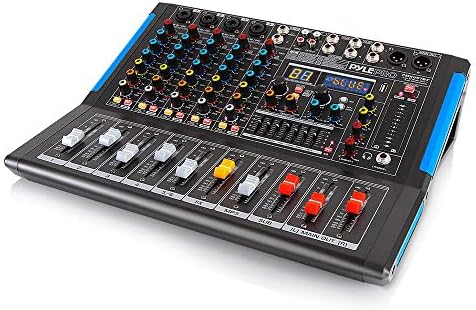


What are the costs of renting a mixing console?
Renting a mixing console provides access to high-end hardware for a specific timeframe, such as a weekend festival or a one-off corporate event. This route allows you to use professional-grade gear that might otherwise be outside your budget or storage capacity. You pay for the duration of use rather than the ownership of the hardware, which includes the cost of the console, transport, and often a technician to operate it.
Renting large scale consoles saves money for one-off projects
Renting beats buying when the cost of the equipment exceeds the amount you would spend on a single rental. For example, if a project requires a large-scale console with 64 inputs, the rental fee for a weekend might be a fraction of the purchase price. This is ideal for hobbyists who need professional results for a single project but do not have a recurring need for the hardware. The rental model also removes the responsibility of maintaining the hardware or keeping it updated with the latest firmware.
If you are considering that specific model, read our full ProFX10 GO review to see how it performs.
Frequent usage makes owning equipment more cost effective than renting
Renting stops making sense when you find yourself needing the same level of equipment more than three times a year. At that point, the cumulative cost of shipping, insurance, and rental fees begins to approach the cost of ownership. If you are a regular performer who needs a consistent setup every week, the lack of ownership becomes a logistical hurdle that outweighs the initial savings.
Is buying a refurbished mixing console a viable option?
Buying a refurbished mixing console involves purchasing hardware that has been returned, inspected, and repaired by the original manufacturer or a certified third party. These units are often sold at a lower price point than new models because they are not “factory fresh.” You receive a device that has been verified to function correctly, often with a limited warranty provided by the refurbisher.
Refurbished consoles provide high end features at a lower price
Refurbished gear is a strong choice when you want a specific high-end feature set but have a strict budget. It allows you to access professional-grade components, such as high-headroom preamps or large-scale routing, for a significant discount. This is particularly effective for older models that are no longer in production but still offer excellent signal paths. You benefit from the fact that the most expensive parts of the console—the internal circuitry and faders—have already been vetted.
You can find the technical specifications in our full XENYX 1002 review before making a purchase.
High failure rates make refurbished units risky for live performances
A refurbished unit stops making sense if the specific model you need has a high failure rate for its primary components, such as the fader bank or the internal power supply. If the refurbisher cannot guarantee a specific number of months on the most-used parts, the risk of a hardware failure during a live performance may outweigh the savings. It is also less viable if you require the latest software features that are only available on the newest hardware revisions.
When is borrowing gear better than buying a mixing console?
Borrowing gear involves using a mixing console owned by a friend, a local studio, or a community organization. This is a zero-cost route to obtaining a mixing desk, provided you can coordinate the logistics of the loan. It is the most common path for beginners who are still determining their specific technical requirements before committing to a purchase.
Borrowing mixing tables helps test workflows during the learning phase
Borrowing beats buying when you are in the “learning” phase of your audio journey. It allows you to see if you actually prefer a certain workflow—such as a digital surface versus an analog desk—without spending money. If you only need to mix a single podcast or a small band’s rehearsal once, borrowing eliminates the need for storage and maintenance. It provides a way to test if your space can physically accommodate the size of the mixing table you are considering.
Check out our full Yamaha AG03 review to see if it meets your podcasting or streaming needs.
Unpredictable schedules make borrowing gear an unreliable production option
Borrowing stops making sense when your requirements become consistent and your schedule becomes unpredictable. Relying on someone else’s gear means you cannot plan a project until the gear is confirmed as available. If you find yourself needing to record or mix every weekend, the lack of reliability and the potential for damage to someone else’s equipment make ownership the only practical path.
Comparison of Mixing Console Alternatives
| Route | Who it suits | Main advantage | Where it breaks down |
|---|---|---|---|
| Digital Audio Workstation | Studio producers and hobbyists | Infinite undo and software flexibility | Lacks tactile control for live mixing |
| Renting Equipment | One-off events and large productions | Access to high-end gear without ownership | Cumulative cost exceeds ownership value |
| Refurbished Gear | Budget-conscious professionals | High-end specs at a lower price point | Risk of component wear on used parts |
| Borrowing Gear | Beginners and occasional users | Zero cost for testing requirements | Lack of availability for consistent work |
When is buying a mixing console the right answer?
Buying a mixing console is the right answer when you require a dedicated, reliable hardware interface for a consistent workflow. This is the correct choice if you need to perform live events where the risk of a software crash or a “borrowed” item being unavailable is unacceptable. If your work requires you to be the primary operator, having a permanent setup allows you to build muscle memory for fader positions and knob locations.
Owning a mixing desk ensures consistent signal chains for permanent studios
Ownership is also the correct choice when you need to own the “signal chain” entirely. If you are building a permanent studio or a recurring live setup, having the hardware on-site ensures that your signal path is always consistent. It becomes the right choice when the cost of a rental or the limitation of a DAW would hinder your ability to produce work at the frequency you require. If you need to connect more than 8 inputs and want to do so with a physical surface, a dedicated mixing desk is the standard solution.