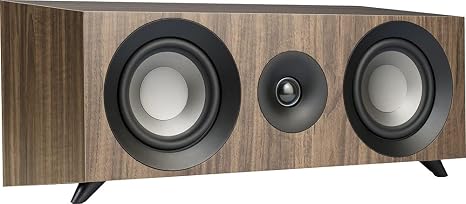
Jamo Studio Series S 83 CEN WL Walnut Center Channel Speaker
Category: Center Channel Speakers
Check Current PriceJamo Studio Series S 83 CEN-WL Walnut Center-Channel Speaker fits movie-focused setups needing clear dialogue. It performs best in rooms where midrange clarity matters more than deep bass. Center-Channel Speakers anchor the front soundstage and direct most spoken words to listeners.
When to Choose the Jamo S 83 CEN-WL for Small Home Theaters
Jamo Studio Series S 83 CEN-WL Walnut Center-Channel Speaker can work in compact theaters when paired correctly. The speaker s dual 127mm woofers and 25mm soft dome tweeter deliver focused midrange that aids intelligibility in constrained rooms. You should add a subwoofer to handle low frequencies below the mains useful range and avoid port-induced boom. At $139 USD, the reviewed Jamo S 83 CEN-WL center-channel speaker provides budget-friendly dialogue clarity for first-time installers who prioritize speech reproduction.
- Tweeter: 25mm (1″) soft dome tweeter
- Woofers: Dual 127mm (5″) polyfiber woofers
- Acoustic technology: WaveGuide for controlled dispersion
- Porting: Rear-firing slot port
- Grille: Seamless magnetic grille
- Intended room size: Larger rooms (but usable in small rooms with subs)
How should I position a center speaker in a compact theater?
Jamo S 83 CEN-WL center-channel speaker delivers focused dialogue when placed on a low stand centered beneath the screen. Place the acoustic center at ear height when seated, typically 90-110 cm above the floor, to align voice imaging. Keep 10-20 cm clearance from the wall to prevent the rear-firing slot port from creating boom and use 8-15 degrees of toe-in to aim direct sound at listeners. Use 16 AWG speaker wire (thicker gauge for better signal) and set distances in your AVR so the center matches timing with left and right speakers.
Harnessing Dialogue Clarity: Center Speaker Criteria for Films
Jamo Studio Series S 83 CEN-WL Walnut Center-Channel Speaker meets the primary criteria for film dialogue reproduction: clear midrange, controlled dispersion, and consistent off-axis tonal balance. The WaveGuide technology narrows tweeter dispersion to improve on-axis clarity while reducing sidewall reflections that blur voices. Choose mains and a center that share tweeter type and timbre to avoid a disjointed front soundstage during complex movie mixes. Compared to horn-bright or overly warm designs, this Jamo center-channel speaker trends toward a neutral, intelligible presentation favored by dialogue-first listeners.
What voice-match and timbre factors matter for front soundstage?
This Jamo center-channel speaker reproduces natural vocals when matched to same-series left and right speakers. Voice matching (ensures tonal similarity) requires the same tweeter material and similar woofer diameters to keep midrange character uniform. Use identical cabinet finishes or models for timbre coherence and set identical crossover points in your AVR to avoid midband lobing. If your left/right speakers differ, apply AVR room correction and manual EQ sparingly to smooth vocal color differences.
Jamo S 83 CEN-WL and AVR matching for immersive movie sound
Jamo Studio Series S 83 CEN-WL Walnut Center-Channel Speaker pairs well with mid-power AVRs that include room correction and flexible crossover options. Look for receivers offering Audyssey, Dirac Live, or Yamaha YPAO to correct in-room peaks and align the center with mains. A typical AVR rated 60-120 watts per channel at 8 ohms will drive most center-channel speakers effectively, though check speaker sensitivity for exact needs. Remember impedance matching (ensures amp and speakers work together) and avoid overpowering small cabinets with excessive gain.
How do I integrate a center with subwoofers and delays?
S 83 CEN-WL center-channel speaker integrates with subwoofers to tighten low-end and preserve dialogue clarity. Set your AVR crossover near 60-80 Hz depending on main speaker bass extension; this shifts low frequencies to the subwoofer and keeps vocals in the center s midrange. Use the AVR s distance/delay settings so measured distances produce time alignment, and verify with an SPL meter or microphone calibration that the center and sub phases align. For smoother bass, deploy one properly placed subwoofer, or two matched subs, then use room correction to flatten peaks and dips.
Common follow-up questions and concise answers
- How loud should I set center levels? Calibrate the center to 75-82 dB C-weighted for dialog checks, then adjust for listening preference.
- Can I wall-mount the center with a rear port? Yes, but allow 10-20 cm clearance behind the cabinet to avoid port reflections and bass build-up.
- Which AVRs pair well for first-time buyers? Mid-range Denon, Marantz, Yamaha, and Sony AVR models with room EQ and 5.1+ channel support offer good value and flexibility.