

Ebservant is reader-supported: some links on this page are affiliate links, and as an Amazon Associate Ebservant earns from qualifying purchases at no extra cost to you. Learn more.
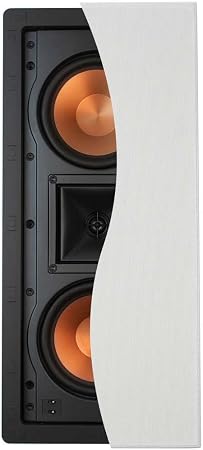
Klipsch R 5502 W II In Wall Speaker Ceiling Speakers
Affiliate links: we may earn a commission. Prices and availability are set by each store.
Yes the Klipsch R-5502-W II suits compact home theaters with high output and clarity. Horn-loaded titanium tweeter and dual Cerametallic woofers increase efficiency. Consider Ceiling Speakers when planning flush-mount LCR channels for discreet room aesthetics.
Why Klipsch R-5502-W II Excels in Small Home Theaters
Klipsch R-5502-W II In-Wall Speaker – Ceiling Speakers delivers high output and focused imaging ideal for small dedicated rooms. The R-5502-W II uses a pivoting Tractrix horn to increase clarity and widen the listening sweet spot. Its drivers produce tight low end and articulate highs that keep dialog intelligible and effects punchy in compact spaces. Horn-loading technology increases acoustic output and lowers distortion, easing amplifier demands for modest AVRs.
Key driver and horn specifications
- Compression driver: 1 x 2.54 cm titanium diaphragm compression driver
- Woofers: Dual 5.25-inch Cerametallic cone woofers
- Horn: Pivoting 90 x 90 square Tractrix horn for adjustable dispersion
- Intended use: left / center / right (LCR) channel duties
- Mounting: horizontal or vertical orientation with in-wall installation
How do driver materials and waveguides shape sound?
Klipsch Ceiling Speakers deliver crisp highs and focused imaging through the titanium compression driver. The pivoting 90 x 90 Tractrix waveguide shapes dispersion to keep dialog centered across multiple seats. Dual 5.25-inch Cerametallic woofers provide tight low end and fast transient response for soundtracks and effects. These materials increase efficiency, allowing smaller receivers to drive home theater LCR arrays effectively.
Installation and Placement Strategies for Compact In-Wall Speakers
Klipsch R-5502-W II In-Wall Speaker – Ceiling Speakers installs flush and targets LCR positions for small theater rooms. R-5502-W II Ceiling Speakers mount horizontally or vertically depending on center-channel or left/right placement needs. Aim the tweeter axis toward the main seating and keep left-right speakers equidistant from the screen for balanced imaging. Because these are in-wall fixtures, you must account for stud spacing and internal depth before cutting drywall.
What wall construction, fire codes, and tools are required?
R-5502-W II requires fire-rated enclosures to meet many local codes. Installers must verify stud bays, cavity depth, and existing insulation before cutting drywall to avoid structural or code violations. Use rated old-work brackets or a fire-rated back box if code or the inspector requires fire stops. If you cannot confirm local code details, hire a licensed installer to avoid compliance problems and electrical hazards.
Recommended tools and materials for in-wall installation
- Stud finder and laser level
- Drywall saw or 3.5-4.5 inch hole saw and jab saw
- Fish tape, wire stripper, and wire staples
- 16 AWG speaker wire (thicker gauge for better signal) and banana or spade connectors
- Fire-rated in-wall back box or old-work bracket when required by code
Klipsch R-5502-W II Integration With Subs and AVRs
Klipsch R-5502-W II In-Wall Speaker – Ceiling Speakers integrates well with subwoofers and modern AV receivers to deliver balanced low frequencies. Ceiling Speakers – in-wall installation, white finish blends visually while the mains handle midrange and high detail. The horn-loaded tweeter reduces power demands on the sub for midbass, letting the sub focus on deep extension. Choosing a compact sub improves in-room bass without overwhelming small theater acoustics.
How do crossover settings, sensitivity and amp power align?
This Ceiling Speaker (R-5502-W II) pairs with modest amplifiers due to horn efficiency. Because Klipsch lists horn-loaded technology, expect elevated sensitivity that lowers required amplifier wattage compared to non-horn designs. Set the AVR crossover near 80-120 Hz so the in-wall speakers handle mids while the sub handles deep bass, and use a 12 dB/octave slope for smooth blending. For a first system, start with an AVR or amp rated 20-100 watts per channel and adjust by ear and SPL measurements.
Practical sub and AVR pairing examples
- Small rooms: SVS SB-1000 paired with AVR set to 80 Hz crossover
- Medium rooms: REL T/5i with 60-80 Hz crossover and room EQ
- Calibration tip: use a SPL meter and tone sweep to set relative levels
Common follow-up questions buyers ask next
Will these speakers work outdoors? No; they lack weatherproofing; choose outdoor models like Klipsch AW-650. What are the required cutout depths? Klipsch does not publish depth; measure cavity and allow 3.5 inches. Which amp power suits them? Start with 20-100W per channel and adjust for room size and sensitivity.