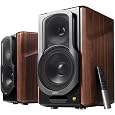
Edifier S3000MKII Audiophile Active Bookshelf Speakers
Category: Bookshelf Speakers
Check Current PriceChoose the Edifier S3000MKII Audiophile Active Bookshelf Speakers when you need accurate nearfield monitoring. It provides 45 Hz to 40 kHz bandwidth and wireless left/right flexibility. These Bookshelf Speakers work as powered studio monitors and versatile hi res playback tools.
When to choose the Edifier S3000MKII in your home studio
Pick the Edifier Bookshelf Speakers when you want compact powered monitors with wide bandwidth and wireless linking. They deliver 45 Hz to 40 kHz frequency response and planar diaphragm tweeter detail for clear top end. These technical specs guide compatibility with interfaces and room setup.
- Type: active / powered, wireless left/right active speaker pair
- Drivers: planar diaphragm tweeter; 6.5-inch long-throw aluminum mid-bass
- Frequency response: 45 Hz to 40 kHz
- Digital: USB audio up to 24Bit/192KHz; Bluetooth 5.0 aptX HD; AirPlay2; WiFi
- Analog/digital connections: Balanced XLR, RCA, Optical, Coaxial
- Dimensions: 19.9 x 13.8 x 16.2 in; Price listed: 899.99 USD
Those specifications ensure the speakers integrate with USB audio, XLR interfaces, and Bluetooth sources. The wireless speaker-to-speaker link reduces cable clutter for small rooms and makes placement flexible. Buyers who prioritize hi-res USB playback and low-latency inter-speaker sync will find these a strong option.
What acoustic treatment matters for small control rooms?
Absorption panels reduce flutter echo and smooth midrange reflections. Bass traps increase low-frequency control and lower modal peaks for small rooms under 4 meters. Install 50 to 80 mm broadband panels at first reflection points and trap two rear corners. The Edifier S3000MKII benefits when you tame room peaks because accurate bass becomes usable.
Match monitors to genre, workflow, and budget in home studios
Match monitors to genre, workflow, and budget by prioritizing bass extension, transient detail, and connectivity. EDM producers need extended low-end and accurate subharmonics, so speakers reaching 45 Hz or lower suit them. The S3000MKII Bookshelf Speaker fits electronic and hybrid genres with 6.5-inch long-throw mid-bass and powerful bass. Singer-songwriters value linear midrange and natural imaging; studio monitors with planar tweeters clearly reproduce vocal detail.
Recommended monitor offers by genre and workflow
- Electronic/EDM: 40-45 Hz extension, tight transient response, and low distortion woofers
- Acoustic/folk: linear 200 Hz-5 kHz midrange, natural dispersion, and low coloration
- Post/film: versatile inputs (XLR, USB, optical) and reliable low-frequency tracking
How should I set levels and calibration for accurate mixes?
Pink noise calibration sets target SPL and reveals room nulls. Aim for 79 to 82 dB C-weighted average at the listening position for mixing sessions. Measure with an SPL meter or REW using a calibrated mic like the MiniDSP UMIK-1. Select balanced XLR input on the speakers for lowest noise when your interface supports it.
Calibration checklist and target values for home studios
- Set listening position at equilateral triangle with speakers (1.0-1.5 m typical distance).
- Use pink noise and REW or SPL meter to reach 79-82 dB(C) averaged; sweep room to find peaks.
- Keep DAW output headroom; aim digital peaks around -6 dBFS and average mix RMS near -18 dBFS.
- Prefer USB 24Bit/192KHz for hi-res referencing; use balanced XLR analog for lowest noise in long runs.
Real-world performance of the Edifier S3000MKII for critical listening
The S3000MKII produces transparent imaging, extended treble to 40 kHz, and usable bass to 45 Hz. These Wireless Bluetooth 5.0 aptX powered bookshelf speakers use planar tweeters and 6.5-inch long-throw woofers for low distortion. Balanced XLR and USB 24-bit/192 kHz support allow direct interfacing for DAW monitoring with minimal conversion. Note missing RMS power spec; audition these against Neumann KH 120, Yamaha HS8, and Genelec 8030.
What connectivity and setup options best suit my interface?
Balanced XLR provides lower noise and cleaner DAW monitoring. Use USB 24Bit/192KHz for the highest-resolution DAW playback when your audio interface supports ASIO or Core Audio. These Edifier bookshelf speakers accept balanced analog XLR, which reduces interference with long cable runs. Avoid Bluetooth aptX HD for critical mixing due to variable latency and potential codec handling differences.
Common buyer questions after reading this guide
- How do these compare to Neumann or Genelec? Audition for your room; these match Neumann imaging but differ in power and nearfield bass response.
- Can I use Bluetooth for mixing? Do not rely on Bluetooth aptX HD for critical mixing due to latency and possible codec variance.
- Do I need a subwoofer? Consider a subwoofer if you produce bass-heavy music and your room lacks low-end extension below 45 Hz.