

Qled Tv prices range from $147.99 to $4997.99, with most buyers selecting models between $497.99 and $1199.99. Peak brightness is the primary specification that increases as the cost of a quantum dot TV rises.
QLED TV Price Levels at a Glance
| Price level | Price range | Products | Median peak brightness | Median native refresh rate | Median rating |
|---|---|---|---|---|---|
| Entry level | $147.99 to $497.99 | 28 | 600 nits | 60Hz | 4.3 |
| Lower mid-range | $497.99 to $799.99 | 29 | 600 nits | 120Hz | 4.3 |
| Upper mid-range | $847.96 to $1199.99 | 29 | 2,000 nits | 144Hz | 4.4 |
| Top end | $1297.96 to $4997.99 | 29 | 2,500 nits | 144Hz | 4.3 |
Products in this category with a full review here
From $209.99 to $1399.99: 3 of the 15 in this category we have reviewed in full.
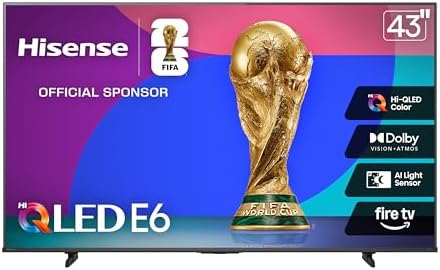


What does an entry level Qled Tv offer?
An entry level Qled Tv provides a median peak brightness of 600 nits and a median native refresh rate of 60Hz. This price point, which has a median cost of $327.99, serves buyers who prioritize a large screen for standard television viewing or casual streaming over high-performance motion handling.
If you primarily watch 24fps films or standard cable television, the 60Hz native refresh rate at this level provides sufficient motion clarity. However, you give up the smoother motion seen in higher tiers, as only 9 of the 22 models in this category reach the 120Hz native refresh rate reference figure. This reference figure marks the requirement for smooth motion in high-frame-rate gaming and sports.
Always verify your purchase by reviewing QLED TV warranties to check before buying.
The entry level is suitable for a bedroom setup or a secondary living room where high-intensity gaming is not the primary use case. If you require a 120Hz native refresh rate for a console like the PlayStation 5 or Xbox Series X, you will likely need to move to the lower mid-range.
What does a lower mid-range Qled Tv offer?
A lower mid-range Qled Tv offers a median peak brightness of 600 nits and a median native refresh rate of 120Hz. With a median price of $597.99, this tier is the point where smooth motion becomes the standard for most quantum dot TVs.
The 120Hz native refresh rate measures the number of times the screen updates per second, which is the standard for fluid gameplay and clear sports broadcasts. In this range, 16 of the 22 models that state a refresh rate meet or exceed this 120Hz requirement. This makes the lower mid-range the baseline for any household that considers gaming a primary activity.
New buyers can learn how technology works in our QLED TV explained guide.
You gain significantly better motion handling compared to the entry level, but you still operate at a median peak brightness of 600 nits. If your room has significant sunlight or you require the high-end brightness used for HDR10+ and Dolby Vision content, you may need to move to the upper mid-range where peak brightness figures reach 2,000 nits.
What does an upper mid-range Qled Tv offer?
An upper mid-range Qled Tv offers a median peak brightness of 2,000 nits and a median native refresh rate of 144Hz. The median price for these models is $997.97.
At this price point, the jump in peak brightness is the defining change. Peak brightness measures the maximum luminance of the display surface, and 2,000 nits allows for much more impactful highlights in HDR content. Furthermore, every single model in this tier (21 out of 21) meets the 120Hz native refresh rate reference figure, with most reaching 144Hz.
This level suits enthusiasts who want a high-brightness experience for cinematic HDR content and high-frame-rate gaming. You gain a substantial leap in brightness over the lower mid-range, which stays at 600 nits. However, you may find that the difference between 144Hz and the 120Hz found in the lower mid-range is less noticeable than the jump from 600 to 2,000 nits.
For a specific model analysis, see our full Hisense 65E6QF review.
What does a top end Qled Tv offer?
A top end Qled Tv offers a median peak brightness of 2,500 nits and a median native refresh rate of 144Hz. These models have a median price of $1797.99.
The top end of the market focuses on maximum luminance and specialized connectivity. All 6 models in this category that state a peak brightness reach at least 2,500 nits. Additionally, this is the only tier where some models include HDMI 2.1, which is the protocol standard necessary for 4K at 120Hz and Variable Refresh Rate (VRR) support.
This tier is for the most demanding users who want the highest possible contrast and brightness for a premium home theater experience. While the 144Hz refresh rate is the same median as the upper mid-range, the increase in peak brightness and the inclusion of HDMI 2.1 provide the technical ceiling for the category. If you do not require 2,500 nits of brightness, the upper mid-range offers a more cost-effective way to achieve 144Hz performance.
You can find a detailed breakdown in our full Hisense 43E6QF review.
Where does paying more stop buying more for a Qled Tv?
The point where price gains flatten depends on whether you prioritize brightness or motion. The median price per unit of peak brightness is $0.57 in the upper mid-range and $0.80 in the top end.
If your goal is simply to reach the 1000 nits reference figure—the minimum peak brightness required to effectively display HDR10+ and Dolby Vision content—the upper mid-range is the most efficient point of purchase. All 5 models in that tier meet the 1000 nits mark, whereas the top end costs significantly more to reach the 2,500 nits level.
Conversely, motion performance flattens much earlier. Both the upper mid-range and the top end share a median native refresh rate of 144Hz. If you only need smooth motion for gaming and sports, there is little data to suggest that the top end provides a motion advantage over the upper mid-range. You are paying for the peak brightness and premium features in the top end, not for a higher refresh rate.
What to budget for on top of the Qled Tv?
Beyond the cost of the television, you must budget for installation hardware and specific cabling to ensure the device functions as intended. These costs are necessary to move the TV from the box to a functional setup.
Evaluate this specific screen in our full Hisense 55E6QF review.
A wall mount is a necessary cost for secure installation on a wall. You must ensure the mount is compatible with the specific weight and VESA (Vertical Edge Spacing Architecture) pattern of your chosen model. Without a compatible mount, the TV cannot be safely secured to a wall surface.
An HDMI 2.1 cable is a required cost if you intend to use the high-performance features of the upper mid-range or top end. This cable is required for 4K at 120Hz and VRR support. If you use a standard HDMI cable, the television may be limited to lower refresh rates or lower resolutions regardless of its internal specs. You must ensure the cable is rated for the full bandwidth of the HDMI 2.1 standard.
How can a buyer tell a fair price for a Qled Tv?
A fair price for a Qled Tv is determined by the price per unit of peak brightness relative to the category medians. This allows you to see how much you are paying for the actual luminance the screen can produce.
View the data-driven results in our full Hisense 85E6QF review.
The median price per unit of peak brightness across the categories is $0.43 for entry level, $0.91 for lower mid-range, $0.57 for upper mid-range, and $0.80 for the top end. When evaluating a specific model, compare its price-to-brightness ratio against these figures. If a model in the upper mid-range has a price per unit of peak brightness significantly higher than $0.57, it may be overpriced for the luminance it provides.
For example, if you are looking at a model that costs $1,000 and provides 1,000 nits, its price per unit of peak brightness is $1.00. Comparing this to the upper mid-range median of $0.57 shows that you would be paying nearly double the average price for that same amount of brightness. Use these medians to identify if a specific price point offers a fair value for the hardware it contains.
Prices were checked in November 2026 and retail prices move based on marketplace fluctuations.
The rest of our quantum dot TV guides
Ebservant is reader-supported: some links on this page are affiliate links, and as an Amazon Associate Ebservant earns from qualifying purchases at no extra cost to you. Learn more.