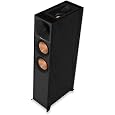
Klipsch R 625FA Floorstanding Home Speaker Black
Category: Floorstanding Speakers
Check Current PriceKlipsch R-625FA vs Polk S55 II sound and room analysis
In most living rooms, horn-loaded speakers throw forward energy while neutral towers blend into room acoustics. This contrast shapes how Floorstanding Speakers perform near walls and in open layouts. Klipsch R-625FA Floorstanding Home Speaker (Black) leverages a Tractrix horn and up-firing driver for forward imaging. Polk S55 II generally sacrifices some top-end sparkle for smoother midrange and denser bass feel.
How do driver design and materials affect long-term fidelity?
Klipsch R-625FA produces durable midbass from dual 6.5-inch spun-copper woofers with low mechanical breakup. The 1-inch aluminum LTS tweeter and 90×90 square Tractrix horn reduce distortion and increase dynamics. Polk typically uses polymer or composite cones that soften breakup while aging predictably under moderate power. Impedance matching (ensures amp and speakers work together) and conservative crossover design both extend usable life and preserve tonal balance.
Choosing floorstanding speakers for home theater and music setups
Choose speakers that match listening priorities: immersive movies or accurate music reproduction. For Atmos home cinema, prefer towers with up-firing modules and higher sensitivity. Klipsch R-625FA Floorstanding Home Speaker (Black) provides built-in up-firing Atmos and lively highs for cinematic impact. Polk S55 II usually pairs better with two-channel stereo setups and audiophile-style room treatments.
What room sizes and layouts best suit tower speaker performance?
R-625FA projects a wide soundstage in medium rooms with controlled bass extension. Place towers at least 2-3 feet from rear walls to reduce boom and tighten low frequencies. Use toe-in to aim imaging toward the main listening seat for improved clarity and center image. Polk S55 II works well in larger rooms where a non-horn voicing fills space more evenly.
Klipsch R-625FA versus Polk S55 II features
Feature-wise, the R-625FA focuses on cinematic height effects and high-efficiency horn loading while the competitor targets neutral voicing and fuller bass. Klipsch R-625FA Floorstanding Home Speaker (Black) ships as a single tower with an integrated up-firing Dolby Atmos driver. The reviewed Klipsch R-625FA floorstanding speaker lists 400 watts handling and 38-21,000 Hz frequency response. Polk S55 II includes ported cabinets tuned for low-end extension and typically uses polymer drivers for a warmer midrange.
Which AVR and source pairings optimize cinematic and stereo sound?
R-625FA Floorstanding Speaker requires a quality AVR with Atmos decoding to unlock its up-firing channel. Choose an AVR that supports speaker levels calibration and room correction like Audyssey or Dirac for best in-room balance. For two-channel music, pair Polk towers with a neutral integrated amp and a low-noise DAC to achieve precise imaging and smoother tonal balance. Use speaker-level trim and subwoofer crossover adjustments to integrate tower low end without muddying mids.
value and placement tips
Budget-conscious buyers will find the Klipsch R-625FA Floorstanding Home Speaker (Black) strong on value at its retail price. At approximately 349 USD per single tower, this unit adds Dolby Atmos capability without a separate add-on module. Polk S55 II often trades the integrated height channel for a more even tonal balance that some music buyers prefer. Consider room acoustics, toe-in, and amplifier choice when comparing cost-to-performance between towers.
Recommended amplifier power, wiring, and placement distances for tower speakers
- Amplifier power: 50-150 watts per channel into 8 for clean headroom with most towers
- Speaker distance: 24-36 inches from rear wall, and 6-12 feet between left and right towers for typical living rooms
- Wiring: 16 AWG for runs under 25 feet; use 14 AWG for runs over 25 feet to reduce resistance
- Subwoofer integration: set crossover near 60-80 Hz and use phase/time alignment via AVR
Match speaker sensitivity to amplifier capability to avoid underpowered clipping that damages drivers. Use impedance matching (ensures amp and speakers work together) guidance in AVR menus to prevent overheating and distortion. If you need clear dialog with cinematic content, prioritize towers with horn-loaded tweeters and an AVR that offers calibration and bass management. Follow-up questions readers search next: Do I need an AVR with Atmos decoding for the R-625FA, and how close to walls should I place towers?
Yes, an AVR with Atmos decoding unlocks the R-625FA’s up-firing channel and improves surround height imaging. Placing towers 2-3 feet from rear walls and angling them inward usually reduces boom and improves center imaging. If your room is very small, consider digital room correction and a compact subwoofer to supplement low bass without overloading the tower drivers.