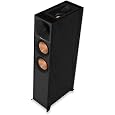
Klipsch R 625FA Floorstanding Home Speaker Black
Category: Floorstanding Speakers
Check Current PriceYes the R-625FA outperforms many rivals inside small home theaters. Its integrated up firing Atmos driver and compact tower save space and channels. This recommendation targets buyers comparing Floorstanding Speakers for tight rooms and simplified Atmos setups.
Klipsch R-625FA: Why it s ideal for small home theaters
Klipsch R-625FA Floorstanding Home Speaker (Black) fits small home theaters by combining a tower footprint with built in height channels. The cabinet preserves floorstanding speaker dynamics while adding an up firing Dolby Atmos driver for vertical localization. Buyers who want fewer boxes will appreciate that this design avoids separate ceiling or stand mounted height speakers. The speaker works as a Floorstanding Speakers option when space and Atmos convenience both matter.
- Dolby Atmos: integrated up firing driver (conforms to Dolby Atmos)
- Drivers: dual 6.5″ spun copper woofers; 1″ aluminum LTS tweeter
- Tweeter horn: 90×90 square Tractrix Horn for controlled directivity
- Power handling: 400 watts; frequency response: 38 Hz – 21 kHz 3 dB
- Porting and build: rear Tractrix port; reinforced MDF cabinet; low profile magnetic grille
- Category and price: floorstanding (tower); single unit listed at 349 USD
How should I position floorstanding speakers in small rooms?
Klipsch R-625FA produces precise imaging and effective height cues when placed correctly. Place the towers about 6-10 feet apart, forming an equilateral triangle with the listening seat when possible. Toe the cabinets inward slightly so the tweeter axes intersect the listening position, which sharpens center imaging and voices. Keep towers 6-12 inches from the rear wall to avoid excessive bass boom while maintaining some room reinforcement.
Floorstanding speaker features that benefit compact room acoustics
Klipsch R-625FA Floorstanding Home Speaker (Black) uses horn loading and spun copper woofers to deliver dynamic response without needing high amplifier power. The 90×90 Tractrix Horn controls directivity so highs stay focused on listeners and avoid exciting sidewall reflections in small rooms. Rear Tractrix porting reduces port noise while preserving low frequencies down to 38 Hz, which often gains room reinforcement in compact spaces. Reinforced MDF cabinet construction minimizes panel resonances that would otherwise smear detail in tight acoustics.
- Tweeter: 1″ aluminum LTS with horn improves efficiency and apparent dynamics
- Woofers: dual 6.5″ spun copper cones balance bass depth and controlled dispersion
- Porting: rear Tractrix port tunes bass while limiting port chuffing
- Power handling: 400 W provides headroom for dynamic movie peaks
What acoustic treatments improve imaging for tower speakers?
Klipsch Floorstanding Speaker benefits from first reflection absorption panels mounted at ear height on sidewalls. Place broadband absorbers at primary early reflection points to tighten imaging and reduce comb filtering between towers and sidewalls. Add a rug and soft sofa to reduce floor reflections and use bass traps in corners if low frequency modes exaggerate boom. For wiring, use 16 AWG wire (thicker gauge for better signal) and check impedance matching (ensures amp and speakers work together) with your amplifier or AVR.
Klipsch R-625FA performance vs rivals for tight home theater spaces
Klipsch R-625FA Floorstanding Home Speaker (Black) stands out against many competitors by bundling height capability into one tower. The built in Atmos transducer makes smaller installs simpler compared with systems that need separate height modules or ceiling speakers. Horn loaded tweeter design emphasizes dynamic contrast and perceived loudness, which many listeners prefer for movies. some rivals focus on neutral tonal balance with different driver layouts instead of horn loading.
Which objective measurements reveal small-room speaker advantage?
R-625FA Floorstanding Speaker delivers useful low end extension and directional control that improve small room performance. Frequency response down to 38 Hz 3 dB shows usable bass without an enormous cabinet, and the 90×90 Tractrix Horn narrows high frequency dispersion to reduce sidewall reflections. When comparing models, evaluate measured on axis frequency response, off axis dispersion plots, and port tuning to see which speaker controls room excitation best. Note that the product sheet lacks sensitivity and nominal impedance numbers, so auditioning with your AVR remains important before purchase.
Common next questions buyers search for include: Do I need an Atmos capable AVR? Yes choose an AV receiver with Dolby Atmos decoding and enough channels for your layout. Can a single R 625FA replace a floor speaker plus separate height modules? Often yes the integrated up firing driver reduces the need for extra height boxes in many small rooms. How should I match subwoofers? Pair a subwoofer with a 80-100 Hz crossover and adjust phase and level for seamless handoff; room EQ helps tame peaks and nulls.