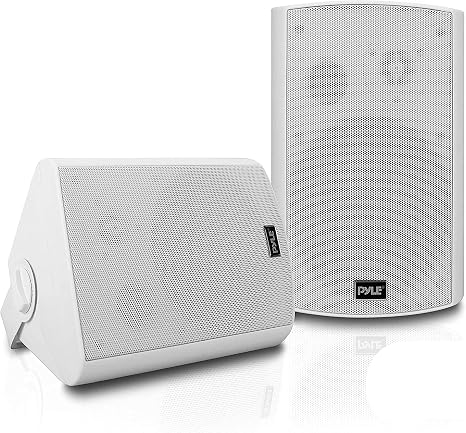
Choose the Pyle PDWR61BTWT Outdoor Wall-Mount Patio Speaker for powered, weather-resistant patio and tailgate setups. It supplies a built-in amplifier, Bluetooth pairing, and IP44 splash protection. This guidance targets Outdoor Speakers buyers weighing power, portability, and marine suitability.
When to Choose Pyle PDWR61BTWT for Outdoor Tailgates
The Pyle PDWR61BTWT Outdoor Wall-Mount Patio Speaker works well for tailgates that need weather-resistant, powered stereo and easy setup. The active speaker includes a passive satellite for genuine left/right playback and daisy-chaining, which simplifies coverage across a campsite or parking-lot tailgate. You can pair phones via Bluetooth 3.0 for playlist control and use the included 12V adapter when mains power is unavailable. These features mean the unit suits casual event hosts who want louder-than-portable Bluetooth speaker sound without hauling a full PA rig.
- Max power output: 300W peak; RMS: 30W + 30W
- Drivers: 6.5″ long-throw woofer; polymer dome tweeter
- Frequency response: 80Hz-20kHz; Impedance: 8 Ohm; Bluetooth range: 30+ ft
- Ingress rating: IP44 (splash-resistant); Power: 110/240V AC and 12V DC adapter included
Can it reliably power sound for 50+ people outdoors?
This Pyle outdoor wall-mount speaker produces about 80 dB SPL at 10 feet, suitable for roughly 40-60 people at conversational-to-music levels. Sound pressure drops about 6-9 dB by 25 feet, which reduces useful coverage for larger crowds. For reliable coverage above 50 listeners, deploy two units in stereo or add a powered subwoofer to restore low-frequency impact. Practical benefit: pairing a second PDWR61BTWT or adding a small powered sub gives festival-style dynamics without a hired PA.
Assessing audio power, battery life, and portability tradeoffs
The Pyle PDWR61BTWT combines a built-in amplifier and passive satellite for more output, but the package lacks an internal battery for true portability. RMS (root mean square) ratings indicate continuous power capability, while peak values show short transient headroom; RMS here totals 60W continuous (30W + 30W). Because the active speaker needs AC or the included 12V adapter, portability depends on your external power plan such as an inverter or a portable power station. Expect a tradeoff: you gain louder, harder-hitting audio than most Bluetooth-only speakers, but you must carry a power source for long, battery-free operation.
- RMS power: 30W + 30W (60W continuous)
- Peak power: 300W (short bursts for transients)
- Power options: 110/240V AC or 12V DC adapter included (no internal battery)
How long will battery last during mixed Bluetooth and mic use?
PDWR61BTWT lacks an internal battery and therefore runs only while AC or 12V power supplies it. The manufacturer does not publish detailed continuous power draw, so you must estimate runtime from RMS power and system inefficiencies. Example calculation below clarifies planning for a 12V battery or portable power station.
- Assumed continuous audio load: 60W (RMS sum of both channels)
- DC draw at 12V ideal: 60W 12V = 5.0 A
- Allowing 80 inverter/amp efficiency: 5.0 A 0.8 6.25 A draw
- 100Ah 12V battery theoretical run: 100 Ah 6.25 A 16 hours (ideal); practical 8-10 hours at 50 depth-of-discharge and real losses
For tailgates, a Jackery Explorer 500 or a 100Ah deep-cycle battery plus a quality inverter tends to power several hours of mixed Bluetooth and mic use. If you need full-day running without recharge, plan for multiple batteries or mains power. Practical tip: run the system at moderate volume and add a small powered sub to reduce continuous amplifier strain.
Pyle PDWR61BTWT limitations for home, RV, and marine use
The Pyle PDWR61BTWT Outdoor Wall-Mount Patio Speaker offers marine-grade housing but shows real limits for specialized home, RV, or boat installations. The IP44 rating protects against splashes and light rain but does not permit immersion or constant spray near bow areas, so saltwater exposure shortens life without extra protection. Installation lacks included mounting hardware and a detailed installation guide, and the manufacturer omits sensitivity and weight figures, which complicates exact placement and bracket selection. For home audio enthusiasts seeking deep bass, the 80Hz low-frequency cutoff means you will likely want a powered subwoofer to reach true low-end response.
- Missing items: warranty details, mounting hardware, sensitivity, weight, and detailed power draw
- Marine suitability: IP44 splash protection, not waterproof for immersion or direct spray zones
- RV compatibility: includes 12V adapter, but check inverter headroom and cabinet ventilation for continuous use
What mounting and weatherproofing limits exist for installation?
Pyle Outdoor Speakers require secure wall mounting and are splash-resistant but not rated for immersion. The IP44 rating protects against splashes from any angle, which suits covered patios and RV awnings but not exposed stern rails on boats. Because the box lacks supplied mounting hardware, mount using marine-grade stainless fasteners, neoprene washers, and exterior silicone sealant at cable entry points to reduce corrosion and water ingress. Practical install tip: use 16 AWG speaker wire for runs under 50 feet, match impedance at 8 Ohm, and place speakers under an overhang when installing near saltwater to maximize product life.
Follow-up buyer questions and quick answers
Can I use a Bluetooth microphone directly with these speakers? The reviewed Pyle PDWR61BTWT outdoor speaker accepts Bluetooth and Aux line-level sources but lacks a dedicated mic preamp. To use a mic, connect a wired microphone to a small mixer or use a Bluetooth transmitter that supports mic input, then feed the line-level output to the speaker’s Aux. This approach gives clearer speech and lets you add EQ or reverb for announcements and sing-alongs.
Will these survive a beachfront installation? PDWR61BTWT has IP44 splash protection but not full marine immersion resistance. For beachfront mounting, place the speakers under a covered area, use marine-grade hardware, and rinse fresh water after salt exposure to prevent corrosion. For direct exposure to spray or open-deck mounting, choose higher-rated marine speakers such as models with IP65+ or purpose-built stainless enclosures.
How can I expand coverage for a large yard or RV park? The PDWR61BTWT supports active-to-passive daisy-chaining, which lets you cluster pairs for wider stereo fields. For larger zones, deploy multiple active/passive pairs, add powered subs like a Klipsch R-10SW or JBL SRX series, and run heavier speaker wire (14-12 AWG) for longer runs. Impedance matching (ensures amp and speakers work together) and planning speaker placement at 8-12 foot spacing improves even coverage without a single loud hotspot.