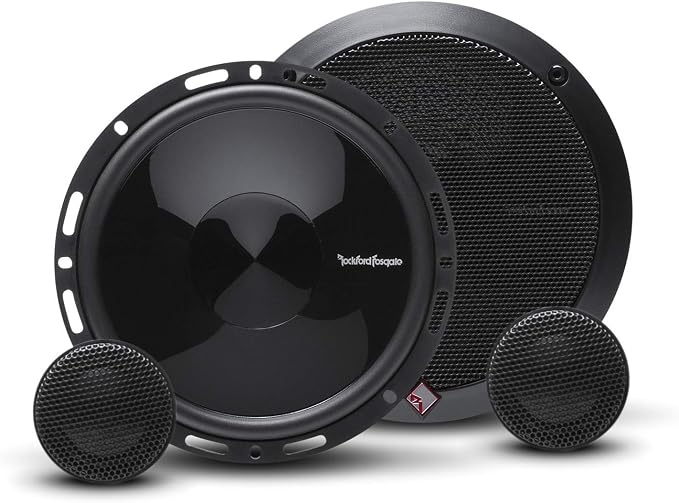
Rockford Fosgate P165 SE Punch 6 5 2 Way Component Speaker System with External Crossover Pair
Category: Component Speakers
Check Current PriceRockford Fosgate P165-SE is probably the best component speaker for compact car upgrades. It delivers clear mids, crisp highs, and controlled bass with an included external crossover. This upgrade belongs in the Component Speakers category for focused stereo imaging.
Rockford Fosgate P165-SE performance upgrades for compact cars
Rockford Fosgate P165-SE Punch 6.5″ 2-Way Component Speaker System with External Crossover (Pair) fits most compact car doors and tight openings. Component Speakers separate tweeter and woofer, so they improve stereo imaging and reduce door-panel coloration in small cabins. Pair Rockford Fosgate P165-SE with a 25-75 W RMS per-channel amplifier for clean dynamics and headroom. The external crossover included with the P165-SE 6.5″ component speaker system enables separate tweeter and woofer level control.
How does factory door mounting affect audio with small speakers?
Factory door mounting reduces low-frequency output. Door panels add resonance and irregular baffle shapes that cancel bass below about 150 Hz in many compact cars. Component Speakers benefit from external tweeter placement and sealed rear chambers to restore midbass punch. Use foam baffles, butyl damping, or 1-2 liter sealed enclosures behind the woofer to control resonance and tighten bass response.
Selecting component speaker size and amp match for compacts
Rockford Fosgate P165-SE Punch 6.5″ 2-Way Component Speaker System with External Crossover (Pair) fits most compact car doors. A 6.5-inch woofer balances cone throw and mounting fit, delivering fuller bass than common 4-inch OEM speakers. Match speakers to an amplifier with clean power, aiming for 25-75 W RMS per channel to avoid distortion and clipping. Alpine MRV-F300 and Rockford Fosgate R2-500X are good budget amp options for these installs.
Recommended amplifier and wiring specifications for compact-car installs
- Driver size: 6.5-inch woofer, 2-way configuration
- Power: target amplifier 25-75 W RMS per channel (clean power)
- Wiring: 16 AWG for runs under 10 feet, 14 AWG for longer runs
- Crossover: external passive crossover included; typical HPF/LPF ranges listed below
Choose amp gain carefully and avoid turning the amp to full gain to limit clipping and distortion. Use impedance matching (ensures amp and speakers work together) to confirm amp and speaker load compatibility. If you plan high-volume listening, prefer an amp with low THD and conservative power ratings. Consider higher-end amps from JL Audio or Focal for tighter bass control if budget allows.
What crossover settings prevent bass boom in tight car cabins?
A 2nd-order high-pass filter at 60-80 Hz reduces bass boom. Apply a gentle 12 dB/octave slope for midbass control while retaining perceived warmth in small cabins. Set the external crossover’s tweeter HPF near 2.5-3.5 kHz and the woofer LPF near 2.5-3.5 kHz for smooth handoff in many compact systems. This approach improves clarity but reduces deepest bass; add a powered subwoofer for true low-frequency extension when needed.
Rockford Fosgate P165-SE installation tips for tight spaces
Rockford Fosgate P165-SE Punch 6.5″ 2-Way Component Speaker System with External Crossover (Pair) fits tight doors. Rockford Fosgate Component Speakers accept spacers, foam baffles, and angled tweeter cups. Choose vehicle-specific wiring harnesses like Metra 70-1801 or Scosche HA2092 for plug-and-play connections and factory integration. Seal speaker openings with neoprene gasket tape and use 16 AWG speaker wire for runs under 10 feet to minimize loss.
Which wiring harnesses and spacers work for shallow speaker installs?
Metra 70-1801 harness provides factory plug compatibility. This harness fits many Honda and Toyota doors, reducing splicing and preserving factory electronics. For GM and Ford models, Scosche HA2092 and Metra 70-6502 offer similar plug-and-play options and correct pinouts. Use 3/8- to 1/2-inch ABS plastic spacers or stamped steel adapters when mounting deeper woofers in shallow doors to protect cones and allow grille clearance.
Follow-up questions and brief answers
Do I need an amplifier for these speakers? Yes, these speakers require an external amplifier because they are passive component speakers. Passive means no built-in amplifier so an external amp must power the drivers. Aim for impedance matching (ensures amp and speakers work together) and conservative power to avoid clipping. A basic 4-channel amp keeps front imaging crisp while powering tweeter crossovers.
Can these speakers replace factory units without modification? Often yes, but you may need adapters, spacers, or tweeter relocation for a proper fit. Check mounting depth, grille clearance, and factory wiring; some vehicles require cutting or brackets. Use Metra or Scosche harnesses to avoid splicing and preserve door chime, alarms, and factory EQ. If door airbags or sensors exist, consult vehicle guides or professional installers before modifying panels.
What crossover adjustments suit noisy highway driving? Raise tweeter level slightly and increase high-pass frequency to preserve clarity at highway speeds. Set tweeter HPF near 3.0-4.0 kHz and woofer HPF to 80-100 Hz to reduce masking by road noise. Use a small time-alignment delay or phase trim to center vocals at the driver’s ear. These changes improve intelligibility but may reduce perceived warmth at low speeds.