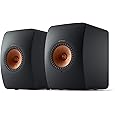
KEF LS50 Meta Passive Bookshelf Speakers Pair Carbon Black
Category: Bookshelf Speakers
Check Current PriceChoose KEF LS50 Meta for imaging; pick Bowers & Wilkins 606 S2 for warmer bass. KEF favors ultra-low distortion and treble detail, while 606 S2 emphasizes musical mid-bass. These Bookshelf Speakers work well in nearfield setups but need weather protection outdoors.
Comparing KEF LS50 Meta and Bowers & Wilkins 606 S2 sound
KEF LS50 Meta Passive Bookshelf Speakers – Pair (Carbon Black) emphasize razor-sharp stereo imaging and extended treble. The 606 S2 delivers fuller midrange warmth and weightier bass that listeners often call more forgiving. Both small speakers reveal room acoustics quickly, so room treatment matters for clarity and tonal balance. Outdoor buyers should note neither model is waterproof, so expect diminished low frequency outdoors and exposure risk without protection.
- MAT reduction: 99 rear-driver absorption (KEF)
- THD (measured claim): 0.07 (KEF)
- Frequency response (-6dB): 47 Hz – 45 kHz (KEF)
- Amplification type: Passive requires external amplifier or receiver (KEF)
How do timbral balance and imaging differ in practice?
KEF LS50 Meta produces tighter imaging with very low coloration. The Uni Q coaxial driver places the tweeter at the woofer axis, improving point source imaging. Bowers & Wilkins 606 S2 uses a more conventional offset driver layout, which yields stronger forward mids and a slightly warmer tonal presentation. Practically, imaging precision favors the KEF indoors, while the B&W often feels more immediately pleasing for casual listeners.
Choosing bookshelf speakers for small rooms and home studios
KEF Bookshelf Speakers (Passive) suit small rooms when used on stands and with nearfield listening. Place speakers on stable stands, not shelves, to reduce cabinet coloration and improve stereo imaging. Match an amplifier to speaker impedance and sensitivity, and use proper speaker cable like 16 AWG for runs under twenty meters. For outdoor deployment, plan weatherproofing or choose outdoor-rated enclosures instead of leaving these compact speakers exposed.
Practical small-room placement checklist for accurate monitoring
- Listening distance: 1.0-2.5 meters from speakers
- Toe-in: aim speakers at the listener for focused imaging
- Distance from rear wall: 20-60 cm to control bass reinforcement
What s the best placement to maximize bass and clarity?
LS50 Meta Bookshelf Speakers benefit from stands placed 30-60 centimeters from rear walls. Reduce sidewall reflections by moving speakers away from hard lateral surfaces and use absorption at first reflection points. Raise tweeters to ear height so the Uni Q axis aligns with the listener for best imaging. Outdoors, elevate speakers above ground and avoid direct proximity to reflective surfaces to limit bass loss and flutter echoes.
Which to buy: KEF LS50 Meta versus Bowers & Wilkins 606 S2
LS50 Meta costs about USD 1,599.99 and targets listeners prioritizing resolution and neutral presentation. The 606 S2 typically sits nearer a mid range budget and favors musical mid-bass, making it more approachable for casual setups. If you want pinpoint imaging, choose the LS50 Meta and budget for a good amplifier and stands. If you want immediate warmth and a lower price point, opt for the 606 S2 and a forgiving solid state amp.
Will one design be easier to upgrade or service over time?
Compact passive bookshelf speakers – high-performance pair complicate driver swaps compared with conventional cabinets. KEF uses the Uni Q driver and MAT technology, which require manufacturer service for correct replacement and calibration. Bowers & Wilkins 606 S2 uses more traditional drivers and crossovers, making field repairs and driver swaps slightly more feasible. For longevity, verify local authorized service and check warranty before purchase.
Q: Can I use these speakers outdoors? A: Neither model is weatherproof; use weatherproof enclosures or buy outdoor speakers. Q: What amplifier power do I need? A: Most bookshelf speakers work well with moderate amplifiers around thirty to one hundred watts per channel, but match nominal impedance (impedance matching ensures amp and speakers work together). Q: How do I minimize room effects? A: Use stands, absorb first reflection points, and keep listening distance close for nearfield monitoring.